CyberScript
Spear Phishing vs Standard Phishing: How SOC Teams Protect Executives from Targeted Attacks
 Updated 16 Mar 2026
Phishing is one of the most frequent and expensive types of cyber threats that companies of large and medium size must deal with currently. The most recent studies of global security reveal that over 80 percent of all reported cyber-attacks start with a phishing email. Losses on email compromise of businesses have gone past billions of dollars per year, and the average data breach cost has since surpassed several million dollars per business. Meanwhile, assailants are automating and applying artificial intelligence to grow campaigns quicker than ever. This has not only rendered phishing a problem for IT but also a broad risk.
The senior leadership and executives are being targeted more since they have the decision-making power, financial resources, and the sensitive details of the company. It has been found by security studies that the inbox of executives is at a much higher targeted rate than the inbox of common employees. Attackers take considerable time to form emails to look authentic so that they regularly pose as trusted vendors, board members, or internal teams. This generalised scamming to attack that is quite personal is the reason why businesses need to have a clear understanding of the differences between spear phishing and traditional phishing and enhance their defence capabilities with a high level of monitoring and response.
Understanding Spear phishing vs standard phishing
Phishing is a broad term that refers to fraudulent attempts to obtain sensitive information, such as passwords, banking details, or confidential company data, by pretending to be a trusted source. However, not all phishing attacks are the same. The main distinction lies in the level of targeting and personalization involved.
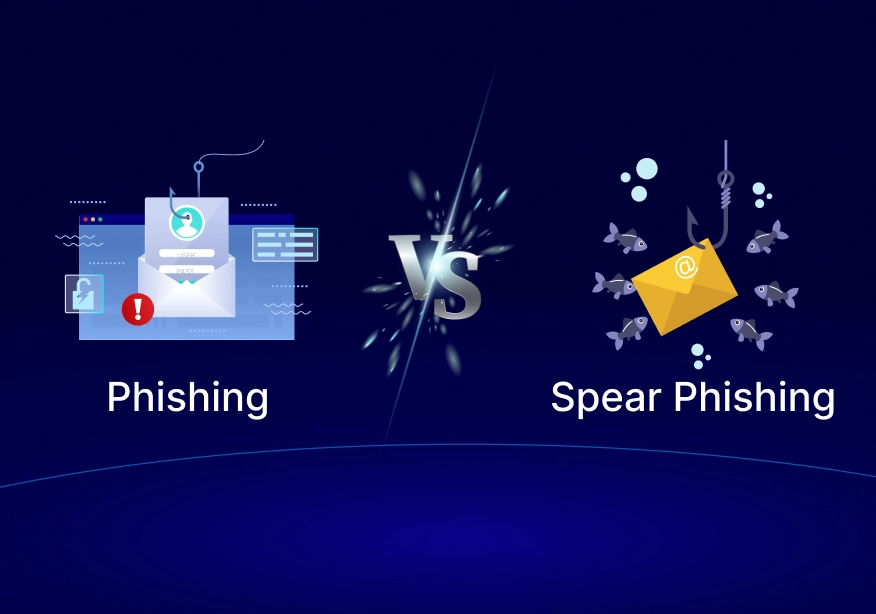
Standard phishing campaigns are usually mass distributed. Attackers send thousands or even millions of identical emails, hoping that a small percentage of recipients will click a malicious link or share sensitive data. In contrast, spear phishing is highly targeted. The attacker researches a specific individual or organization and crafts a tailored message designed to build trust and trigger action.
Understanding the difference between phishing and spear phishing is critical for enterprises because the level of risk and the defense mechanisms required are very different. While spam filters may block many generic phishing emails, targeted spear phishing attacks can bypass traditional controls if organizations rely only on basic email security tools.
Protect Your Executives with Advanced Cybersecurity Solutions
Partner with Q3 Technologies to deploy AI-driven phishing detection, executive-focused monitoring, and real-time SOC protection tailored to your enterprise risk profile.
What is Standard Phishing? Common Tactics and Business Risks
Standard phishing attacks rely on volume. Attackers often impersonate well-known brands such as banks, cloud providers, or e-commerce platforms. These emails typically contain urgent language such as “Your account will be locked” or “Immediate action required.” The goal is to create panic and push the user to click a malicious link.
Common tactics include fake login pages, malware attachments, and fraudulent password reset requests. Once the victim enters credentials, attackers can access corporate systems, move laterally across the network, or deploy ransomware. Even though these emails are not personalized, they still cause major damage because of their scale.
For enterprises, the business risks are significant. A single compromised employee account can expose sensitive data, disrupt operations, and lead to regulatory penalties. Standard phishing also increases helpdesk workload and can damage customer trust if data is leaked. This is why many organizations now invest in managed security services for phishing protection to continuously monitor, detect, and respond to threats in real time.
What is Spear Phishing? How Targeted Attacks Exploit Executives
Spear phishing is a more advanced and dangerous form of phishing. Instead of sending bulk emails, attackers focus on specific individuals such as CEOs, CFOs, board members, or senior managers. They gather information from social media, company websites, press releases, and even previous data breaches to craft convincing messages.
For example, an attacker may impersonate a vendor and reference an ongoing project or pretend to be a CEO requesting an urgent wire transfer. Because the message contains accurate details and appears legitimate, executives may not question it. In many cases, these attacks result in large financial losses within minutes.
This is where executive cybersecurity protection becomes critical. High-level leaders require enhanced monitoring, stricter access controls, and advanced email security policies. Organizations must go beyond basic spam filters and deploy layered defenses that include behavioral analysis, real-time threat intelligence, and human-led SOC monitoring.
Difference between phishing and spear phishing: Key Security Gaps in Organizations
When analyzing the difference between phishing and spear phishing, organizations must go beyond definitions and focus on the practical security gaps that allow these attacks to succeed. Below are the critical gaps enterprises must address in detail:
Lack of Target-Specific Security Controls
Standard phishing defenses often focus on filtering bulk spam. However, spear phishing is personalized and can bypass traditional filters. Many companies fail to apply stronger monitoring rules for executives, finance teams, and privileged users, leaving them exposed.
Insufficient Identity and Access Management
In standard phishing, compromised credentials may affect one employee. In spear phishing, attackers target high-level accounts with elevated access. Without strict role-based access controls, multi-factor authentication, and continuous identity monitoring, the impact can spread quickly across systems.
“The problem wasn’t that businesses wanted too much from chatbots. The problem was that rule-based systems were architecturally incapable of delivering what conversational intelligence actually requires.” — Q3 Technologies AI Practice
Weak Executive-Focused Monitoring
Generic email security tools are not enough to detect subtle impersonation attempts aimed at senior leaders. Organizations must deploy enhanced logging, anomaly detection, and privileged account monitoring as part of executive cybersecurity protection strategies.
Limited Behavioral Analytics
Traditional tools rely on signature-based detection. Spear phishing often uses new domains or carefully crafted messages that look legitimate. Without AI-driven phishing detection, it becomes difficult to identify suspicious communication patterns or unusual login behavior.
Delayed Incident Response
In mass phishing, the response may involve password resets. In spear phishing, the response window is much shorter, especially in cases involving wire transfer fraud. Enterprises must integrate real-time monitoring with SOC services for phishing protection to reduce detection and response time.
Poor Security Awareness Training
Employees are often trained to recognize generic phishing emails, but not sophisticated, research-based spear phishing attempts. Training programs should include executive-level simulations and real-world scenarios.
Fragmented Security Infrastructure
Many organizations operate separate tools for email security, endpoint protection, and network monitoring. Without centralized visibility, threats can move undetected. Partnering with an experienced IT infrastructure services company ensures integrated monitoring across systems.
Lack of Continuous Risk Assessment
Spear phishing campaigns evolve quickly. Enterprises must conduct ongoing vulnerability assessments, simulate phishing attacks, and continuously refine policies to stay ahead of attackers.
Addressing these gaps requires a layered approach that combines advanced technology, trained security teams, and proactive governance frameworks.
Upgrade Your Enterprise Defense Against Targeted Phishing
Collaborate with Q3 Technologies to implement layered security strategies, managed detection services, and intelligent threat monitoring built for modern enterprises.
How do spear phishing attacks differ from standard phishing attacks in Real-World Scenarios?
To fully understand enterprise risk, it is important to answer the question above:
In real-world scenarios, standard phishing might involve a generic “update your password” email sent to thousands of employees. The attacker does not know who will click. Success depends on chance. In contrast, spear phishing may involve a carefully crafted email to a CFO referring to a real acquisition deal. The attacker may even spoof a known vendor’s domain or use a lookalike email address.
Standard phishing often leads to credential theft at the user level. Spear phishing, however, can lead to executive account compromise, fraudulent fund transfers, and direct access to confidential board communications. The financial and reputational impact is usually much higher.
Because of this, enterprises are increasingly adopting SOC services for phishing protection that combine human expertise with advanced analytics. Security Operations Centers monitor email activity, detect anomalies, and respond immediately when suspicious behavior is identified.
Why Executives and CXOs Are Prime Targets for Advanced Phishing Campaigns
Executives hold sensitive information, approve financial transactions, and have access to strategic data. Attackers see them as high-value targets. In many organizations, senior leaders also have broader system privileges, which makes their accounts extremely powerful if compromised.
Another reason executives are targeted is time pressure. CXOs often work across multiple time zones and respond quickly to emails. Attackers exploit this urgency by sending messages marked “confidential” or “urgent.” They may also impersonate board members or legal advisors to increase credibility.
A comprehensive defense requires not only policy enforcement but also intelligent monitoring. With AI phishing detection with SOC integration, enterprises can analyze email patterns, detect abnormal communication behavior, and flag suspicious activity before damage occurs. AI can identify subtle changes in writing style, login locations, or transaction behavior that may indicate compromise.
Read Our Case Study: Strengthening Azure Cloud Security with a Risk-Based Vulnerability Assessment for Australia’s Prestigious Educational Institution
Compliance, Governance, and Risk Management in Phishing Protection
Phishing attacks are not just technical incidents; they are compliance and governance risks. Regulations across industries require organizations to protect customer data and demonstrate strong cybersecurity controls. A successful phishing attack that leads to a data breach can trigger investigations, fines, and legal action.
Risk management frameworks now require proactive measures such as regular employee training, simulated phishing tests, and continuous monitoring. Organizations must document their controls and ensure rapid incident response procedures are in place.
Modern enterprises are turning to AI-driven phishing detection tools that use machine learning to identify suspicious patterns across email traffic, user behavior, and network activity. These systems reduce false positives while increasing detection accuracy. When combined with expert monitoring teams, they create a layered defense that meets regulatory expectations and strengthens governance practices.
How Q3 Technologies Supports Enterprise Security
Q3 Technologies helps enterprises strengthen their defense posture against phishing and targeted cyber threats through a strategic and technology-driven approach. As a trusted Cybersecurity development company, Q3 delivers customized solutions that align with enterprise risk profiles and regulatory requirements. Below is how Q3 supports enterprise security in detail:
Comprehensive Security Assessment and Risk Analysis
Q3 begins with a deep evaluation of the organization’s existing infrastructure, identifying gaps in email security, identity protection, and executive monitoring. This helps enterprises understand vulnerabilities related to phishing and spear phishing threats.
AI-Powered Threat Detection Implementation
Through advanced AI-driven solution development, Q3 integrates intelligent detection systems capable of analyzing user behavior, email patterns, and network activity. This enables early detection of suspicious communication and credential misuse.
Advanced Monitoring with SOC Integration
Q3 deploys real-time monitoring frameworks that combine automation with expert oversight. With AI phishing detection with SOC integration, organizations benefit from continuous alert validation, rapid escalation, and immediate response actions.
Executive-Focused Security Controls
Recognizing that leaders are prime targets, Q3 implements enhanced identity protection, access monitoring, and communication safeguards as part of its executive cybersecurity protection approach.
Managed Detection and Response Capabilities
Q3 provides ongoing monitoring and remediation support through structured managed security services for phishing protection, ensuring enterprises receive round-the-clock visibility and rapid threat containment.
Infrastructure-Level Security Strengthening
As an enterprise-grade IT infrastructure services company, Q3 ensures that security measures extend beyond email to include cloud workloads, endpoints, APIs, and hybrid environments.
Secure Your Organization with Proactive SOC Protection
Work with Q3 Technologies to strengthen identity controls, enhance executive cybersecurity protection, and reduce phishing risks with integrated security solutions.
Conclusion
Phishing attacks continue to evolve in speed, scale, and sophistication. While standard phishing campaigns remain widespread, spear phishing poses a greater threat to executives and enterprise leadership. The financial and reputational damage from targeted attacks can be severe and immediate.
Understanding spear phishing vs standard phishing is the first step toward building an effective defense strategy. Enterprises must combine advanced email protection, identity management, executive-focused monitoring, and real-time SOC response. By adopting intelligent, AI-powered detection systems and partnering with experienced cybersecurity experts, organizations can reduce risk and protect leadership teams from targeted threats.
FAQs
1. How does spear phishing differ from standard phishing attacks?
Spear phishing is highly targeted and personalized, aimed at a specific individual or organization using researched information. Standard phishing is mass-distributed, where attackers send the same message to thousands of users, hoping someone clicks. Spear phishing usually causes more serious financial and reputational damage because it targets privileged accounts.
2. How can companies protect against spear phishing?
Companies can protect against spear phishing by implementing multi-factor authentication (MFA), strong identity and access management, AI-powered email filtering, executive-focused monitoring, and continuous SOC (Security Operations Center) oversight. Regular employee training and simulated phishing exercises are also essential.
3. Which is more successful, targeted attacks or spear phishing?
Spear phishing is itself a form of targeted attack and is generally more successful than generic phishing. Because messages are personalized and well-researched, victims are more likely to trust them, especially when they appear to come from senior leaders, vendors, or trusted partners.
4. Which type of phishing targets high-level executives?
Whaling is the type of phishing that specifically targets high-level executives such as CEOs, CFOs, and board members. It is a specialized form of spear phishing designed to exploit executive authority and financial access.
5. What are executive-level targeted phishing emails?
Executive-level targeted phishing emails are carefully crafted messages sent to senior leaders. These emails often impersonate board members, vendors, or internal teams and may request urgent wire transfers, confidential documents, or login credentials.

Table of Content
- Understanding Spear phishing vs standard phishing
- What is Standard Phishing? Common Tactics and Business Risks
- What is Spear Phishing? How Targeted Attacks Exploit Executives
- Difference between phishing and spear phishing: Key Security Gaps in Organizations
- How do spear phishing attacks differ from standard phishing attacks in Real-World Scenarios?
- Why Executives and CXOs Are Prime Targets for Advanced Phishing Campaigns
- Compliance, Governance, and Risk Management in Phishing Protection
- How Q3 Technologies Supports Enterprise Security
- FAQs
Looking for a Trusted Technology Partner?
From AI development and chatbot solutions to enterprise software and mobile apps, Q3 Technologies delivers end-to-end technology services..