Energy
How Mobile Apps Help Save Energy and Reduce Fuel Costs: A Smarter Way to Live
 Updated 02 Apr 2026
Key Takeaways
- The global smart energy management apps market is projected to reach $14.4 billion by 2034 (CAGR: 17.1%).
- Energy usage analytics apps are set to reach $8.26 billion by 2030 at a CAGR of 16.4%.
- The broader smart energy market will surpass $330 billion by 2030.
- Fuel-saving mobile apps now cover EVs, smart meters, fleet management, and home automation.
- Q3 Technologies’ utility app achieved 5M+ downloads and improved bill payment speed by 10x.
- AI, IoT, and 5G are the next frontier for smart energy apps through 2030.
- Smart energy tracking and energy management apps are converging into unified platforms for homes, fleets, and industrial assets.
- Fuel delivery app development companies are emerging as a high-growth category serving oil distributors, LPG suppliers, and EV charging operators.
Energy bills are rising. Fuel costs remain volatile. And yet, millions of people and businesses are finding a surprisingly powerful ally in their pocket: the smartphone.
The idea that a mobile app could meaningfully slash your electricity bill or reduce fleet fuel consumption by double-digit percentages once seemed far-fetched. Today, it is mainstream. Smart energy apps now connect directly to smart meters, EV chargers, solar panels, HVAC systems, and even industrial grid infrastructure — giving users real-time visibility and automated control over how they consume energy.
This is not just a consumer trend. It is a global energy revolution, backed by serious capital, government mandates, and rapid advances in AI and IoT. Software development companies across the world are racing to build the next generation of fuel saving mobile apps, Smart Energy Tracking Apps, and utility platforms that will define how we live, commute, and operate businesses over the next decade.
This blog unpacks everything: the best apps available today, real-world use cases, a landmark case study from Q3 Technologies, and what the next five years will look like.
The Scale of the Opportunity
The numbers tell a compelling story of accelerating demand.
The global smart energy management apps market is forecast to reach $14.4 billion by 2034, growing at a compound annual growth rate of 17.1%. North America leads with a 36.8% market share, but Asia-Pacific is the fastest-growing region, driven by China’s grid modernisation investments and India’s rollout of 250 million smart meters.
Zooming out to the broader smart energy ecosystem, the market was valued at $199.5 billion in 2024 and is projected to surpass $330 billion by 2030 — a figure that underscores how central digital tools have become to global energy infrastructure.
And the eco-friendly apps market as a whole — which includes energy, water, and waste management tools — is expected to grow by $127.3 billion by 2032 at a CAGR of 24.73%.
The message for businesses, consumers, and software development companies is clear: smart energy apps are not a niche category. They are a core pillar of the coming decade’s economic and sustainability landscape.
How Mobile App Development is Powering the Energy Revolution
The energy revolution is not happening in power plants alone. It is happening in app stores. Mobile app development has become one of the most important levers for energy transformation, for a simple reason: apps bridge the gap between complex energy infrastructure and everyday human behaviour.
Real-Time Consumption Monitoring via Smart Energy Tracking Apps
A Smart Energy Tracking App connects to advanced metering infrastructure (AMI) and displays live usage data broken down by appliance, circuit, or facility zone. When users can see exactly how much electricity their air conditioner, water heater, or EV charger is consuming at any given moment, behavioural change follows naturally. Research from the Netherlands found that smart meter-connected apps effectively stimulated households to modify their energy consumption patterns over a 16-month study period.
Energy Management App Dashboards for Businesses
The modern Energy Management App goes far beyond a simple bill viewer. Enterprise-grade platforms consolidate data from multiple utility accounts, renewable energy sources, battery storage, and HVAC systems into a single dashboard — enabling facility managers to make informed, data-driven decisions about procurement, load shifting, and capital investment. For multi-site organisations, this visibility can translate into six-figure annual savings.
Predictive Analytics and AI Recommendations
The latest generation of fuel saving mobile apps uses machine learning to analyse consumption patterns and predict future usage. Apps like Sense (for homes) and Geotab (for fleets) use AI to flag anomalies — such as a refrigerator running inefficiently — and recommend corrective actions before they become expensive problems.
Automated Scheduling and Demand Response
Apps integrated with smart thermostats, EV chargers, and smart appliances can automatically shift energy-intensive tasks to off-peak hours when electricity rates are lower. This is called demand-side management, and it saves both money and stress on the grid.
Fleet and Logistics Fuel Optimisation
For businesses operating fleets, fuel is one of the largest operational expenses. Mobile app development targeting fleet managers now delivers route optimisation, driver behaviour scoring, idle time alerts, and fuel consumption benchmarking — all from a smartphone dashboard.
Carbon Footprint Tracking
Regulatory pressures, particularly from the EU’s Energy Efficiency Directive targeting a 32.5% improvement by 2030, are pushing businesses to track and report emissions. Mobile apps now make this straightforward, automating data collection and generating compliance-ready reports.
Turn Energy Consumption Into Intelligent Savings
Partner with Q3 Technologies to build smart energy apps that cut costs, optimize usage, and deliver real-time insights across homes, fleets, and enterprises.
Best Fuel Saving Mobile Apps and Smart Energy Apps
Here is a curated list of the most impactful apps across key categories:
1. Home Energy Management
- Emporia Energy — Provides real-time electricity consumption breakdowns, cost projections, and customisable alerts. Integrates with smart home devices and utility providers for automated optimisation. Ideal for homeowners wanting granular visibility.
- Google Nest / Home App — Connects to Nest thermostats, sensors, and compatible devices. Uses AI to learn household schedules and automatically adjust heating and cooling, delivering average savings of 10–15% on energy bills.
- OhmConnect — Gamifies energy saving by rewarding users with cash and prizes for reducing consumption during peak demand events. Partners with utilities across North America to run automated demand-response programmes.
2. Fuel and EV Optimisation
- GasBuddy — Crowdsourced fuel price tracking across North America. Drivers save, on average, hundreds of dollars annually by routing to cheaper stations. Increasingly integrating EV charging station data.
- PlugShare — The go-to app for EV drivers to locate charging stations, check real-time availability, and plan routes with charging stops. Supports over 500,000 charging locations globally.
- Fuelzee — Combines fuel price comparison with loyalty reward tracking, helping drivers stack savings across multiple fuel retailer programmes.
3. Fuel Delivery App Development: A Fast-Growing Category
A distinct and rapidly growing segment of the energy app space is on-demand fuel delivery — and it is creating significant demand for specialist companies.
Apps like Booster Fuels, Filld, and Yoshi pioneered the concept of fuel delivered directly to parked vehicles, cutting the need for drivers to visit petrol stations. In markets like India, apps such as Humsafar and FuelBuddy are disrupting traditional LPG and diesel distribution by enabling doorstep delivery with real-time tracking, digital payment, and consumption history.
The core features that a capable fuel delivery mobile app development company must deliver include:
- GPS-enabled order placement and live driver tracking
- Dynamic pricing integration
- Automated reorder triggers based on tank sensors
- Multi-payment gateway support
- Route optimisation for delivery fleets
- Compliance with fuel safety and regulatory requirements
For oil distributors, LPG suppliers, and commercial fuel operators, investing in a custom fuel delivery app — built by an experienced fuel delivery app development company — can eliminate manual dispatch, reduce delivery errors, and open new revenue streams in a market that is growing as urbanisation and convenience culture accelerate.
- Geotab MyGeotab — Enterprise-grade fleet management app delivering fuel consumption analytics, driver scoring, route optimisation, and regulatory compliance reporting. Used by thousands of fleets globally.
- Samsara Driver App — Real-time fleet visibility with fuel usage monitoring, harsh braking/acceleration alerts (key fuel wasters), and integration with ERP systems.
- Fuelly — Beloved by individual drivers and small fleet operators for its simplicity. Tracks fuel economy across fill-ups and benchmarks against similar vehicle models.
4. Utility and Grid Apps
- Sense — Uses AI to detect individual appliances on your home circuit and monitor their energy consumption, providing actionable insights to eliminate energy waste.
- Fuel Economy Mobile (U.S. DOE/EPA) — Official government app calculating fuel costs, gas usage, and greenhouse emissions across vehicle models. Invaluable for car buyers comparing lifetime fuel costs.
- Alternative Fueling Station Locator (U.S. DOE) — Locates nearby alternative fuel stations offering biodiesel, propane, hydrogen, and EV charging — essential for fleet operators transitioning to cleaner fuels.
Real-Life Use Cases: From Households to Industrial Fleets
Use Case 1: AI-Driven Smart Energy Optimization Reduces Electricity Costs by 20%
A leading utility provider in Texas enabled suburban households to reduce electricity costs by leveraging smart metering and an AI-powered mobile app that delivers real-time energy insights and automated optimization. The platform identified that a pool pump running during peak hours (2–6 PM) was significantly increasing monthly expenses and recommended shifting usage to off-peak hours (10 PM–2 AM), which the user implemented via the app’s scheduling feature. This simple yet data-driven intervention resulted in a 20% reduction in the electricity bill—saving $95 per month—while also enhancing customer engagement, improving energy efficiency, and contributing to better grid load management for the utility.
Use Case 2: A Logistics Company Reduces Diesel Costs by 18%
A mid-sized delivery company in the UK deploys Geotab across its 120-vehicle fleet. The platform’s AI analyses driving patterns and identifies that 34% of vehicles idle for more than 45 minutes daily, consuming diesel unnecessarily. Drivers receive in-cab alerts and coaching via the mobile app. After 90 days, idle time drops by 60%, fuel consumption falls 18%, and the company saves approximately £240,000 annually.
Case Study: How Q3 Technologies Transformed Energy Engagement for 5 Million+ Customers
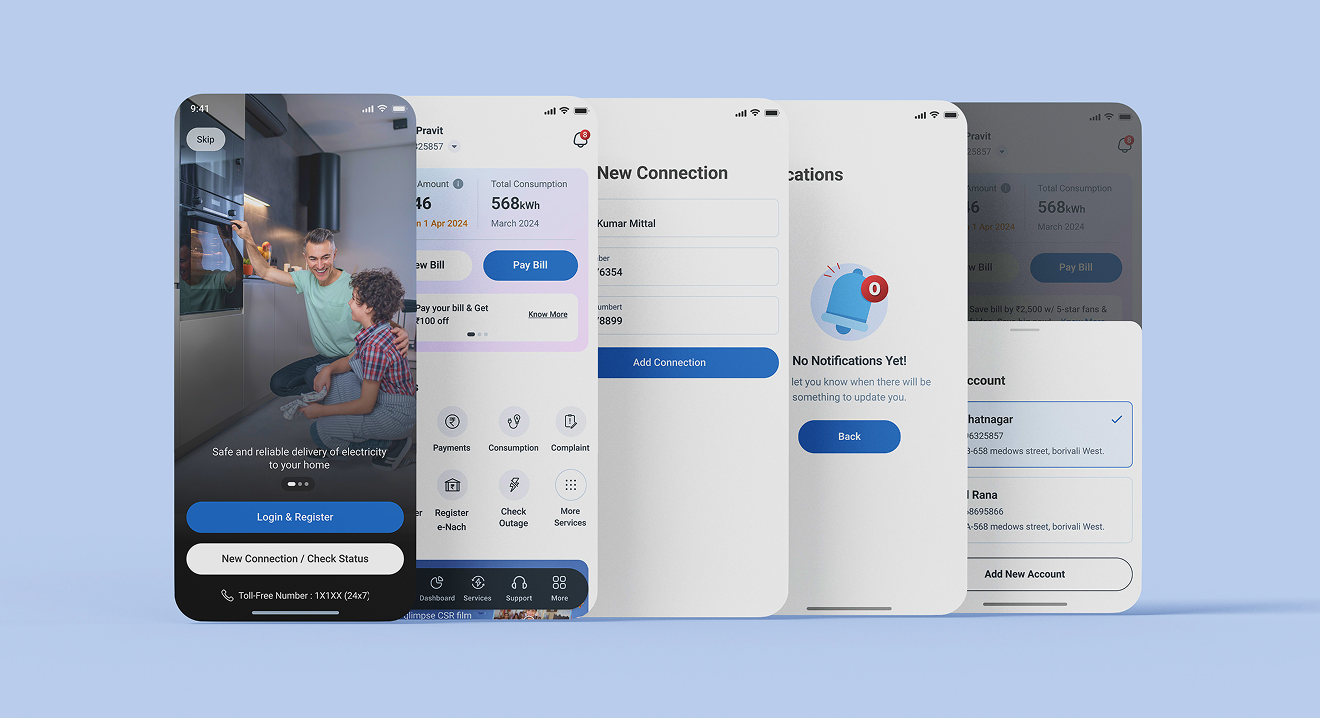
Perhaps the most compelling proof of what mobile app development can achieve in the energy sector comes from Q3 Technologies’ work with one of India’s largest electricity distribution companies — a utility serving over 5 million customers across 400 square kilometres in Mumbai and surrounding areas.
The Challenge
The utility’s existing mobile app was failing on multiple fronts. UI and functionality issues had generated low ratings and negative user reviews, creating friction in the customer relationship at precisely the moment when digital energy management was becoming critical. The company needed a complete transformation — not just a cosmetic update.
The Solution
Q3 Technologies undertook a full overhaul, rebuilding the app from the ground up for improved performance and maintainability. The rebuilt app was introduced:
- Enhanced Customer Interaction — In-app messaging, push notifications, and personalised alerts replaced generic communications, giving customers timely, relevant information about their consumption and billing.
- Real-Time Support — An integrated chatbot provided immediate assistance, reducing call centre volumes and improving satisfaction scores.
- Seamless Integration — The app was integrated with the utility’s SAP system, multiple payment gateways, and a rewards points management engine — creating a cohesive digital experience that connected billing, usage, and incentives in one place.
- 10x Faster Bill Payments — The streamlined payment flow dramatically reduced friction, turning what was previously a multi-step frustration into a quick, reliable transaction.
The Outcomes
The results speak for themselves:
| Metric | Result |
|---|---|
| Application Downloads | 5 Million+ |
| Bill Payment Speed | 10x Improvement |
| Google Play Store Rating | 4.1 / 5 (up from poor) |
| App Store Rating | 4.7 / 5 |
Read Our Case Study: Driving Customer Engagement and Boosting Efficiency with a Versatile Utility App for India’s Largest Electricity Distribution Company
7 Proven Benefits of Fuel Saving Mobile Apps
- Immediate Cost Savings. Energy and fuel costs drop when users gain visibility and control. Behavioural changes triggered by app insights typically deliver 10–20% reductions in consumption within 3–6 months.
- Elimination of Energy Waste. Apps identify phantom loads, inefficient appliances, and wasteful behaviours that users are often entirely unaware of. This is money that was previously invisible.
- Optimised Billing. Time-of-use tariff optimisation — shifting consumption to cheaper off-peak windows — can save households hundreds and businesses thousands annually, automatically.
- Fleet Efficiency Gains. Commercial fleets using mobile fuel management apps report consistent reductions in fuel spend of 12–25%, with additional gains from reduced maintenance costs driven by safer, more efficient driving.
- Carbon Footprint Reduction. Energy savings translate directly to emissions reductions. For organisations with sustainability commitments or regulatory obligations, apps provide the data trail needed for reporting and verification.
- Improved Customer Experience. For utilities, a well-designed app increases customer satisfaction, reduces inbound support calls, and improves payment rates — as the case study demonstrates compellingly.
- Competitive Differentiation. Businesses that adopt smart energy tools gain a cost advantage over competitors who still manage energy manually. This is increasingly a strategic differentiator in margin-sensitive industries.
Latest Trends Shaping Smart Energy Apps
The smart energy app landscape is evolving rapidly. Here are the key trends that software development companies and enterprises must watch:
AI-Powered Personalisation
Next-generation Smart Energy Tracking Apps move beyond dashboards to proactive, personalised recommendations. AI models will predict your energy needs, pre-condition your home, and automatically negotiate demand-response credits with your utility — without you lifting a finger.
Convergence of Smart Energy Tracking Apps and Energy Management Apps
The boundary between consumer-facing Smart Energy Tracking Apps and enterprise Energy Management Apps is dissolving. Platforms like Arcadia, Urjanet, and Enverus are building unified layers that serve households, SMBs, and industrial operators on a single data architecture — allowing utilities and software partners to serve the entire market from one platform.
Vehicle-to-Grid (V2G) Integration
EVs are becoming mobile batteries. Apps will increasingly manage bidirectional energy flows — drawing from your car’s battery during peak hours and replenishing it overnight when rates are low.
Smart Meter Mandates Driving App Adoption
Australia’s Energy Market Commission has set a 2030 deadline for full smart meter coverage. Europe requires 80% smart meter penetration by 2028. India is rolling out 250 million smart meters. Each smart meter is a data endpoint that fuels app-driven energy management.
Hyperlocal Carbon Tracking
Regulatory pressure — including the EU’s requirement for member states to achieve annual end-use energy savings of 1.9% by 2028–2030 — is driving demand for apps that automatically track and report carbon data at the asset, site, and fleet level.
5G-Enabled Real-Time Control
As 5G infrastructure matures, smart energy apps will achieve true real-time control over distributed energy resources, enabling millisecond-level responses to grid signals and making demand-response far more precise.
Integration with Building Management Systems (BMS)
The line between a mobile energy app and a full building management system is blurring. Johnson Controls’ acquisition of Webeasy signals the industry’s direction: unified digital ecosystems where mobile is the front-end to a deeply integrated building intelligence layer.
Gamification and Social Energy
Apps like OhmConnect have shown that gamifying energy saving — leaderboards, cash rewards, social comparison — drives sustained behaviour change beyond what information alone achieves.
AI and IoT Readiness
The next wave of smart energy apps will be powered by predictive AI and IoT integration. Ensure your software development partner has active capability in these areas, not just a slide deck about them.
Power Your Business with Next-Gen Energy Apps
Collaborate with Q3 Technologies to design AI-driven energy and fuel management platforms that drive efficiency, sustainability, and measurable ROI.
Interactive Self-Assessment: Is Your Organisation Ready for a Smart Energy App?
Answer these five questions to gauge your readiness:
- Do you have real-time visibility into your energy or fuel consumption? If no → a smart energy app could deliver immediate ROI by illuminating hidden waste.
- Are your customers or employees able to manage energy-related tasks digitally? If no → you are creating unnecessary friction and missing engagement opportunities.
- Do you track and report on energy costs or carbon emissions regularly? If manually → automation through a mobile app will save hours of work and reduce reporting errors.
- Does your fleet have telematics data integrated with a driver-facing app? If no → you are almost certainly overspending on fuel and maintenance.
- Has your energy app been reviewed or redesigned in the last 2 years? If no → user expectations have shifted significantly, an outdated app actively damages engagement.
If you answered “no” to two or more of these questions, your organisation has a clear opportunity to use mobile app development to capture significant energy and cost savings.
The Bottom Line: Mobile Apps Are the Infrastructure of the Energy Revolution
The energy revolution is not just about wind farms and solar panels. It is about putting intelligent tools in the hands of every consumer, driver, facility manager, and utility operator — tools that turn complex energy data into simple, actionable decisions.
Fuel saving mobile apps, Smart Energy Tracking Apps, and Energy Management Apps are delivering that intelligence on a scale. From a Mumbai family paying their electricity bill 10 times faster to a U.S. logistics company cutting diesel costs by nearly a fifth, the evidence is consistent and compelling: when software development companies — including specialist fuel delivery app development companies — build well-designed, deeply integrated energy apps, the outcomes are measurable, meaningful, and lasting.
The next five years will see this space accelerate dramatically, driven by AI, 5G, smart meter mandates, EV proliferation, and tightening carbon regulations. The organisations that invest in smart energy app capability now — whether as a utility, an enterprise, or a software development company — will be best positioned to lead in a world where energy intelligence is no longer optional.
Ready to Build Your Smart Energy App?
Whether you are a utility services provider looking to transform customer engagement with a best-in-class Energy Management App, an enterprise seeking to deploy a Smart Energy Tracking App across facilities, a fuel distributor ready to modernise with a custom-built delivery platform, or a business aiming to cut fleet fuel costs, the right mobile app can be your most powerful energy management tool.
Q3 Technologies has demonstrated exactly what is possible — turning a struggling utility app into a 5-million-download platform with industry-leading ratings. Our expertise spans mobile app development, SAP integration, AI-powered chatbots, scalable cloud architecture, and energy sector-specific engineering — making us a trusted partner whether you need a Smart Energy Tracking App, a full Energy Management App, or a fuel delivery platform built from the ground up.
Frequently Asked Questions
What is a Smart Energy Tracking App?
A Smart Energy Tracking App goes beyond basic bill viewing to provide real-time, granular monitoring of energy consumption — often at the appliance, circuit, or facility level — using data from smart meters, IoT sensors, and connected devices. Unlike a standard utility app that shows monthly billing summaries, a Smart Energy Tracking App delivers live data, anomaly alerts, historical trend analysis, and actionable recommendations for reducing waste. Examples include Sense, Emporia Energy, and enterprise platforms like Arcadia.
What features should a good Energy Management App have?
A robust Energy Management App should offer multi-site energy monitoring, time-of-use tariff optimisation, integration with renewable energy sources and battery storage, automated demand-response participation, carbon footprint reporting, and customisable alerts. For businesses, integration with ERP/SAP systems and utility billing platforms is essential. The best Energy Management Apps also include mobile-first dashboards with role-based access so facility managers, finance teams, and sustainability officers each see the data most relevant to them.
What does a fuel delivery app development company build?
A fuel delivery app development company builds mobile platforms that enable on-demand or scheduled fuel delivery — covering petrol, diesel, LPG, kerosene, or EV charging — directly to customers or commercial sites. Core features include GPS-based order placement, live driver tracking, automated dispatch and route optimisation, digital payment integration, tank-level monitoring, and regulatory compliance tools.
How much can a fuel saving mobile app actually save?
Results vary by use case, but documented outcomes include: 10–20% reduction in household electricity bills, 12–25% reduction in fleet fuel costs, and $100–$135/month in EV fuel and maintenance savings compared to petrol vehicles. Business outcomes are typically larger and faster given higher baseline consumption.
What technologies power the best smart energy apps?
Leading smart energy apps leverage native iOS (Swift) and Android (Kotlin) development, RESTful APIs, IoT data integration, AI/ML for predictive analytics, cloud-native backends, and integration with SAP, smart meter AMI platforms, and payment gateways.
How long does it take to build a utility or energy app?
A basic MVP can be delivered in 3–4 months; a full-featured enterprise utility app with SAP integration, payment gateways, chatbot, and multi-platform support typically takes 6–12 months, depending on scope and complexity.
Which software development companies specialise in energy apps?
Q3 Technologies is a recognised leader in this space, with specific expertise in utility mobile apps, energy and utilities industry software, and enterprise integration. Their case study with one of India’s largest electricity distributors is one of the most well-documented examples of energy app transformation at scale.

Table of Contents
- The Scale of the Opportunity
- How Mobile App Development is Powering the Energy Revolution
- Best Fuel Saving Mobile Apps and Smart Energy Apps
- Real-Life Use Cases: From Households to Industrial Fleets
- Case Study: How Q3 Technologies Transformed Energy Engagement for 5 Million+ Customers
- 7 Proven Benefits of Fuel Saving Mobile Apps
- Latest Trends Shaping Smart Energy Apps
- Interactive Self-Assessment: Is Your Organisation Ready for a Smart Energy App?
- The Bottom Line: Mobile Apps Are the Infrastructure of the Energy Revolution
- FAQs
Looking for a Trusted Technology Partner?
From AI development and chatbot solutions to enterprise software and mobile apps, Q3 Technologies delivers end-to-end technology services..

Explore More
Mobile Applications
Mobile App Development Process: Step by Step Guide
Health Insurance App