Managed IT
Cloud Managed Services vs Traditional IT Support: Which Model Fits Your Organization?
Summary
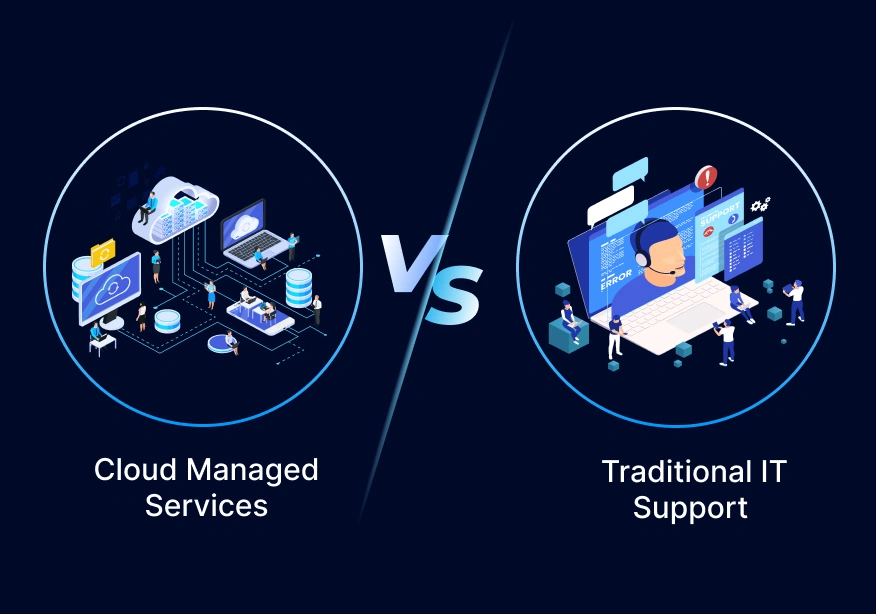
Choosing between Cloud Managed Services and Traditional IT Support is a strategic decision that impacts scalability, security, operational efficiency, and long-term IT costs. This blog compares both models to help organizations identify the right approach based on their infrastructure, business goals, and digital transformation roadmap.
There is a moment most IT managers recognize: the team is stretched, the same problems keep recurring, and the budget for resolving them never quite covers the cost of preventing them. Cloud managed services offer one way out of that cycle — but they are not the right answer for every organization, and the case for switching is rarely as simple as a cost comparison.
This article sets out how cloud managed services and traditional IT support differ across the dimensions that actually matter to IT buyers: cost, scalability, response times, security, and internal capacity. If you are evaluating whether to move away from a break-fix or in-house model, Q3’s Managed IT Services team works through exactly this decision with clients across the UK, India, UAE, and Australia.
Why Traditional IT Support Struggles to Keep Pace?
Traditional IT support typically means one of two things: an internal team that owns your infrastructure end-to-end, or a break-fix arrangement where an external provider responds after something fails. Both rely on the assumption that IT issues can be addressed effectively through reactive support after they occur.
Under a break-fix model, your provider has no financial incentive to prevent issues and no visibility into your systems until you raise a ticket. Response times are a function of availability, not obligation. There are no service-level agreements (SLAs) governing how quickly a critical outage gets resolved.
In-house teams offer genuine advantages like familiarity with your environment, institutional knowledge, direct accountability, but their capacity is fixed. When demand spikes, whether from a new site opening, a system migration, or a critical failure at 2 a.m., the team absorbs it. Over time, routine maintenance crowds out strategic work. Burnout becomes a real operational risk.
Neither model scales cleanly. Neither delivers the around-the-clock remote infrastructure monitoring that hybrid and multi-site environments increasingly depend on. And neither tends to produce the documented, auditable service levels that board-level governance now expects.
How Cloud Managed Services Operate and Where They Add Value
Cloud managed services shift the operating model from reactive to proactive. A managed service provider (MSP) monitors your infrastructure continuously through automated tooling, flagging anomalies before they escalate into failures. Your organization moves from unpredictable capital expenditure to a defined monthly subscription, with responsibilities governed by a formal SLA.
The provider takes on a defined scope: uptime commitments, patch management, security monitoring, helpdesk response, and reporting. Q3’s Cloud Infrastructure Services cover the full stack — from infrastructure design and cloud migration to ongoing operations management on platforms including Microsoft Azure.
Cloud-based delivery means support is not tied to a physical location. Whether your workforce is distributed across three offices or largely remote, the support model is consistent. Scalability is structural capacity adjusted with your workload, not your hardware procurement cycle.
One misconception worth addressing directly: cloud managed services are not exclusively an enterprise proposition. Organizations with 100 to 1,500 employees are often where the return is highest. At that scale, building an internal team capable of 24/7 monitoring, modern cybersecurity practices, and cloud operations management is genuinely expensive. Outsourced IT services provide enterprise-grade capability at a fraction of the cost.
Read Our Case Study: Strengthening Azure Cloud Security with a Risk-Based Vulnerability Assessment for Australia’s Prestigious Educational Institution
Traditional IT vs Cloud IT
The table below compares both models across the dimensions IT buyers consistently cite as most important in vendor assessments.
| Dimension | Traditional IT Support | Cloud Managed Services |
|---|---|---|
| Cost structure | Unpredictable; capital-heavy | Predictable monthly opex; no hardware spend |
| Scalability | Constrained by hardware and headcount | On-demand — scales with workload, not procurement |
| Response times | Dependent on staff availability | 24/7 monitoring with defined SLAs |
| Security posture | Reactive patching; internal accountability | Proactive monitoring; shared responsibility model |
| Internal capacity | Day-to-day ops consume strategic bandwidth | Team freed for projects and business priorities |
| Disaster recovery | Manual and costly to maintain separately | Built-in redundancy across cloud regions |
| Visibility | Siloed; often discovered after failure | Centralized dashboards and real-time alerting |
The Real Cost of Staying with Legacy IT Support
The total cost of traditional IT support is rarely what the headline budget reflects. Several significant costs sit outside the IT line item:
- Unplanned downtime: Mid-market organizations face measurable revenue and productivity losses per hour of unplanned outage. Remote infrastructure monitoring reduces that exposure by catching issues before they cause system failure.
- Opportunity cost: When your internal IT team spends the majority of their time on maintenance and incident response, strategic projects — cloud migration, security uplift, data platform builds — are deprioritized or delayed indefinitely.
- Security gaps: Reactive patching means vulnerabilities remain open longer. Q3’s Cybersecurity Services sit alongside managed IT to ensure proactive threat detection rather than post-incident remediation.
- Recruitment and retention: Finding IT generalists who can cover infrastructure, security, cloud operations, and end-user support is increasingly difficult. Outsourced IT services offer access to a broader skills pool without permanent headcount risk.
- Shadow IT risk: When internal support is slow or inaccessible, staff find their own workarounds — typically using unapproved tools that sit outside your security perimeter and outside your compliance controls.
These costs are invisible on a single invoice, which is exactly why they tend to be underestimated until a significant incident forces them into focus.
Identifying Which Model Suits Your Organization’s Stage
This is the question that matters most — not which model is theoretically superior, but which one fits where your organization is right now and where it is headed in the next two to three years.
Managed IT support is likely the better fit if:
- Your IT team’s capacity is consumed by reactive support, leaving limited bandwidth for projects or strategy.
- You operate across multiple sites or have a significant remote workforce that needs consistent, reliable access to systems.
- Your current setup does not include documented SLAs, 24/7 monitoring, or regular performance reporting.
- You have experienced recurring outages or slow resolution times that are directly affecting business operations.
- Compliance requirements: data protection, industry regulation, or client-mandated security standards are becoming harder to evidence with your current model.
- You are planning growth: new locations, acquisitions, or significant headcount increases that your current IT model would struggle to absorb cleanly.
Traditional or hybrid IT may still make sense if:
- You operate highly specialized or proprietary systems that require deep institutional knowledge to support, and that knowledge currently sits in-house.
- Your regulatory environment mandates on-premises data processing that cannot be moved to a cloud model.
- You have an internal IT team with genuine capacity and the budget to provide proactive, around-the-clock coverage across your full environment.
If the first list describes your organization more than the second, a structured conversation with Q3’s IT Consulting and Strategy team is a useful starting point before committing to any particular model or contract.
Q3 Technologies’ Approach to Cloud-Managed IT
Q3 Technologies has delivered managed IT and cloud infrastructure services for enterprise clients across India, the UK, UAE, and Australia for over 25 years. Clients include Samsung, Panasonic, Vedanta, and FirstGroup. Our managed services cover remote infrastructure monitoring, cloud operations management on Microsoft Azure, and 24/7 helpdesk support — all under defined SLAs and backed by CMMI Level 3 and ISO 27001 certification.
CMMI Level 3 and ISO 27001 are not marketing designations. They reflect documented, independently audited processes governing how we manage client environments. For organizations in regulated sectors or those with formal supplier assurance requirements, they provide evidence not just assurance.
Every engagement begins with a structured assessment of your current environment: where dependencies sit, where the risks are, and what a transition to managed services would involve practically. The objective is to give you a clear picture of what is possible and what it would take — not to close a contract on the first conversation.
Our 24/7 Support Services are available independently or as part of a broader managed services engagement, depending on where your organization’s needs sit on the traditional IT vs cloud IT spectrum.
The Decision Is About Direction, Not Just Cost
The comparison between cloud managed services and traditional IT support is ultimately a question about trajectory. Can your current IT model keep pace with where your organization is going? Not where it sits today, but across the next two to three years — more locations, more remote users, tighter compliance, a more complex threat landscape.
Cloud managed services and outsourced IT services more broadly exist to answer that question with a clear yes. Traditional IT support, at its best, answers it with effort and contingency. That is a meaningful operational difference — and one worth evaluating formally before the next significant incident makes the decision for you.
Frequently Asked Questions
What are cloud managed services, and how do they differ from traditional IT support?
Cloud managed services provide proactive monitoring, maintenance, cybersecurity, and cloud infrastructure management through a managed service provider (MSP). Unlike traditional IT support, which often follows a break-fix approach, managed services continuously monitor systems to identify and resolve issues before they disrupt your business.
Are cloud managed services suitable for small and mid-sized businesses?
Yes. Cloud managed services are an excellent fit for small and mid-sized organizations that need enterprise-grade IT support without the cost of maintaining a large in-house IT team. They offer predictable monthly costs, improved security, and scalable IT resources to support business growth.
How can cloud managed services improve cybersecurity for businesses?
Managed service providers strengthen cybersecurity through continuous threat monitoring, regular security updates, vulnerability management, endpoint protection, and rapid incident response. This proactive approach helps businesses reduce cyber risks while supporting compliance with relevant data security and privacy regulations.
Is traditional IT support still a good option for some organizations?
Yes. Traditional IT support can still be suitable for organizations with highly specialized on-premises systems, strict operational requirements, or an experienced internal IT team capable of providing proactive support. However, many growing businesses benefit from combining in-house expertise with managed cloud services.
How much do cloud managed services cost?
The cost varies depending on your business size, number of users, cloud environment, and required support level. Most managed service providers offer flexible monthly pricing, allowing businesses to budget more effectively compared to unpredictable break-fix IT expenses.
When should a business consider switching to cloud managed services?
If your business experiences recurring IT issues, frequent downtime, limited internal IT capacity, or plans to expand across multiple locations or remote teams, it may be time to move to cloud managed services. A professional IT assessment can help determine the best operating model based on your business goals and technology requirements.

Table of content
- Why Traditional IT Support Struggles to Keep Pace
- How Cloud Managed Services Operate and Where They Add Value
- Traditional IT vs Cloud IT
- The Real Cost of Staying with Legacy IT Support
- Identifying Which Model Suits Your Organization’s Stage
- Q3 Technologies’ Approach to Cloud-Managed IT
- The Decision Is About Direction, Not Just Cost
- FAQs