AI
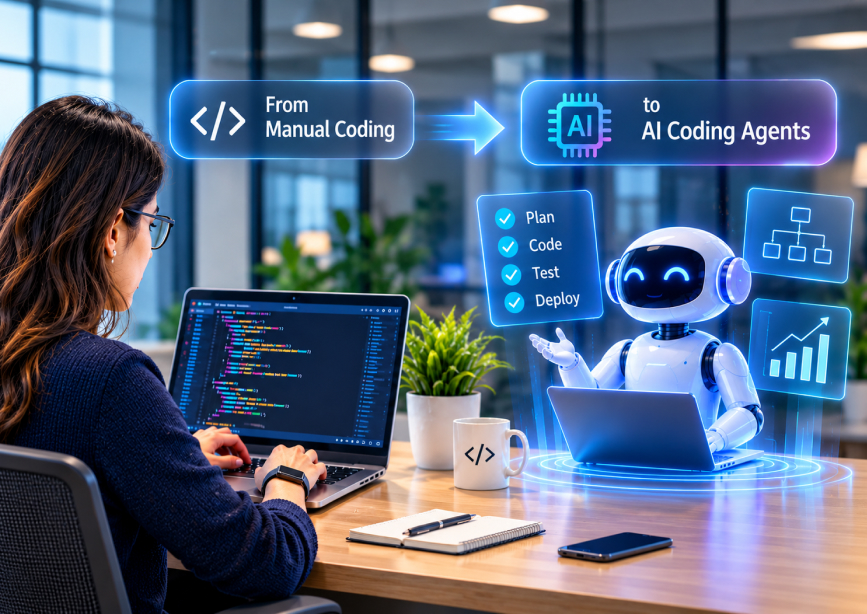
From Manual Coding to AI Coding Agents: Is This the Future of Software Engineering?


Summary
AI coding agents are AI systems that can take a software task, such as fixing a bug, adding a feature, or upgrading a library, and complete it across multiple steps: reading the codebase, planning changes, editing files, running tests, and proposing the result for human review. They mark the shift from AI that suggests code to AI that does engineering work.
Over the past year, one question has come up in almost every engineering conversation I’ve had at Q3 Technologies: “If an AI agent can open a pull request on its own, what does my team look like in two years?”
It’s the right question, and it deserves a better answer than either the hype (“engineers are obsolete”) or the dismissal (“it’s just fancy autocomplete”). The truth sits in between, and it is far more interesting.
The direction of travel is clear. Gartner predicts that by 2028, 90% of enterprise software engineers will use AI code assistants, up from less than 14% in early 2024. What is changing now is what those assistants do. They are no longer limited to completing a line of code. They plan tasks, navigate repositories, run tests, and iterate on their own output.
What Are AI Coding Agents?
An AI coding agent is an AI system that can autonomously or semi-autonomously carry out a software engineering task from instruction to proposed solution. Unlike a code-completion tool that waits for a developer to type, an agent works toward a goal.
A typical coding agent workflow looks like this:
- Understand the task from a ticket, prompt, or issue description.
- Explore the codebase to find relevant files, dependencies, and conventions.
- Plan the change and break it into steps.
- Edit code across one or more files.
- Run tests, linters, and builds, then fix what fails.
- Propose the result as a pull request with an explanation for human review.
The defining difference is the loop: the agent acts, observes the result, and adjusts, much as a developer would.
From Manual Coding to AI Coding Agents: The Evolution
| Era | What the AI does | What the engineer does |
|---|---|---|
| Manual coding | Nothing; tools are editors, compilers, and debuggers | Writes, tests, and documents every line |
| AI autocomplete | Predicts the next line or block of code | Writes most code, accepts or rejects suggestions |
| AI chat assistants (AI pair programming) | Answers questions, explains code, generates snippets on request | Asks, copies, adapts, and integrates |
| AI coding agents | Executes multi-step tasks: edits files, runs tests, opens pull requests | Defines tasks, provides context, reviews and approves |
| Multi-agent engineering | Specialized agents plan, code, test, and review in coordination | Designs the system, sets guardrails, owns outcomes |
Most enterprises today sit between the second and third rows. The leading teams are experimenting with the fourth, and a few are piloting the fifth.
How Are AI Coding Agents Changing Software Engineering?
The data shows a profession in transition, with enthusiasm and skepticism rising together.
- Usage is mainstream: Stack Overflow’s 2025 Developer Survey of more than 49,000 developers found 84% use or plan to use AI tools.
- Trust is falling: The same survey found 46% of developers don’t trust the accuracy of AI output, up from 31% the year before.
- Agents are emerging, not dominant: Only 31% of developers were using AI agents, 17% planned to, and 38% had no plans to adopt them.
- Those who use agents see gains: Among developers using agents at work, 69% reported increased productivity.
- AI is an amplifier: Google’s 2025 DORA research found AI magnifies the strengths of high-performing organizations and the weaknesses of struggling ones.
In practice, here is what changes on an engineering team that adopts agents seriously:
- The unit of work shifts from lines of code to well-specified tasks.
- Code review becomes the critical path, because generation is fast and verification is not.
- Context becomes infrastructure. Architecture rules, coding standards, and domain knowledge must be written down so agents can use them.
- Testing moves from “nice to have” to “precondition.” An agent without a reliable test suite has no way to know when it is wrong.
The Productivity Reality Check
This is where I want to be candid, because the marketing and the evidence don’t always agree.
In a randomized controlled trial, the research group METR studied 16 experienced open-source developers completing 246 real tasks on mature repositories they knew well. With early-2025 AI tools, they took 19% longer than without them, even though they estimated afterward that AI had made them about 20% faster.
That does not mean AI coding tools don’t work. It means three things:
- Gains depend on the task: Agents shine on well-defined, repetitive, or exploratory work, and struggle with big, context-heavy changes in large codebases.
- Verification has a cost: Reviewing, correcting, and re-prompting AI output takes real time.
- Measure outcomes, not impressions: Teams should track lead time, change failure rate, and rework, not how fast developers feel.
The tools have improved significantly since early 2025, and so has the industry’s understanding of how to use them. But the lesson stands: productivity comes from process design, not from the tool alone.
Will AI Coding Agents Replace Manual Coding?
No, but they will replace a lot of the work engineers used to do by hand. The more useful question is which skills grow in value.
| Skills that matter less | Skills that matter more |
|---|---|
| Typing speed and syntax recall | Problem framing and task specification |
| Writing boilerplate and CRUD code | System design and architecture |
| Manual test writing for routine paths | Test strategy and verification judgment |
| Searching documentation | Context engineering: structuring knowledge for agents |
| Solo implementation | Reviewing, steering, and orchestrating AI agents |
| Memorizing APIs | Security, performance, and domain expertise |
Gartner’s Philip Walsh captured the shift well when he said engineers will focus on “steering AI agents toward the most relevant context and constraints.” That is still engineering, and arguably a more senior form of it.
The real risk is not replacement but skills erosion. If junior developers accept AI output they don’t understand, they won’t build the judgment senior engineers rely on. Enterprises need to design mentoring and review practices that keep learning in the loop.
Where AI Coding Agents Deliver Value Today
Based on what we see in enterprise programs, these are the highest-return use cases right now:
- Test generation: Expanding unit and integration test coverage on existing code.
- Legacy code comprehension: Explaining, documenting, and mapping dependencies in older systems.
- Upgrades and migrations: Framework version bumps, library replacements, and API migrations across many files.
- Bug triage and fixes: Reproducing issues, proposing fixes, and adding regression tests.
- Documentation: Keeping READMEs, API docs, and change notes current.
- Internal tools and prototypes: Fast iteration where requirements are clear and risk is low.
And where humans should stay firmly in charge: novel architecture decisions, security-critical logic, regulated workflows that require traceable human authorship, and anything irreversible in production.
The Risks Enterprises Must Manage
- Security of generated code: Agents can introduce vulnerable patterns or outdated dependencies. Every agent-generated change needs automated security scanning.
- Over-broad access: An agent that can push to production or read secrets is a privileged identity and must be governed as one.
- Rising costs: Agentic workflows consume far more compute than autocomplete. Gartner predicts AI coding costs will surpass the average developer’s salary by 2028 as token consumption surges.
- Intellectual property and data exposure: Clear policies are needed on which tools are approved and what code can be shared with external models.
- Quality drift: Code that passes tests can still be hard to maintain. Human review must cover design, not just correctness.
A Five-Step Playbook for Adopting AI Coding Agents
- Fix the foundations first: Reliable CI/CD, good test coverage, and documented standards. Agents amplify what they find.
- Start with bounded, high-volume tasks: Test generation, dependency upgrades, and documentation are ideal pilots.
- Engineer the context: Give agents architecture guidelines, coding conventions, and domain rules in a structured, versioned form.
- Set guardrails before scale: Least-privilege repository access, mandatory human review, security scans, and per-team usage budgets.
- Measure and expand: Track lead time, change failure rate, rework, and agent pull request acceptance rate. Scale what the data supports.
Alos Read: Why 80% of Enterprise AI Automation Projects Fail and How Q3 Fixed It
Expert View
AI coding agents don’t remove the need for great engineers. They raise the bar for what great engineering means. The teams that win will be the ones that can tell an agent exactly what to build, prove that what it built is right, and know when not to use it at all.
Hitesh Goyal, Senior AI Solutions Manager at Q3 Technologies
How Q3 Technologies Helps Enterprises Adopt AI Coding Agents
With 25+ years of custom software engineering, Q3 Technologies helps enterprises move from experimentation to governed, measurable adoption of agentic coding:
- AI-powered software development: A review of your SDLC, test maturity, toolchain, and team skills, with a prioritized adoption plan.
- Governed agent pipelines: CI/CD with built-in AI code review, automated test generation, security scanning, and human approval gates.
- Context engineering: Structuring your architecture standards, domain rules, and legacy knowledge so agents produce consistent, compliant code.
- Modernization acceleration: Using agents to analyze, document, and incrementally refactor legacy applications.
- Team enablement: Training engineers to specify, steer, and review AI-generated work effectively.
Quick Tips for Engineering Leaders
- Pilot on your best-tested codebase, not your messiest one.
- Treat agent pull requests like a new hire’s: review everything until trust is earned with evidence.
- Version your prompts and context files alongside your code.
- Set a token budget per team before agents scale, not after the first invoice.
- Pair juniors with seniors on AI review so judgment is learned, not skipped.
Is Your Engineering Team Ready for the Future of Software Engineering?
The shift from manual coding to AI coding agents is real, and it is accelerating. But the future of software engineering will not be decided by which tool you buy. It will be decided by how well you redesign your process, governance, and skills around it.
Frequently Asked Questions
What are AI coding agents?
AI coding agents are AI systems that complete multi-step software tasks, such as reading a codebase, editing files, running tests, and proposing changes, with human engineers reviewing and approving the result.
How are AI coding agents different from AI code assistants?
Code assistants suggest code while a developer types. Coding agents work toward a goal across multiple steps and tools, acting, checking results, and iterating with less moment-to-moment human input.
How are AI coding agents changing software development?
They shift the engineer’s role from writing every line to specifying tasks, providing context, and reviewing output. Code review, automated testing, and documented standards become critical to the process.
Will AI coding agents replace software engineers?
No. They automate much routine coding work but increase the value of system design, verification, security, and domain expertise. Demand is shifting toward engineers who can direct and evaluate AI.
Do AI coding agents actually improve productivity?
They can, depending on the task and the team’s foundations. Developers using agents often report gains, but controlled research shows perceived speed can exceed measured speed, so enterprises should track delivery metrics.
What are the risks of using AI coding agents in the enterprise?
The main risks are insecure generated code, over-broad system access, rising AI usage costs, IP and data exposure, and skills erosion among junior developers.
How should an enterprise start with AI coding agents?
Start with strong test coverage and CI/CD, pilot agents on bounded tasks like test generation or upgrades, add guardrails and review gates, and scale based on measured results.

Table of content
- What Are AI Coding Agents?
- From Manual Coding to AI Coding Agents: The Evolution
- How Are AI Coding Agents Changing Software Engineering?
- The Productivity Reality Check
- Will AI Coding Agents Replace Manual Coding?
- Where AI Coding Agents Deliver Value Today
- The Risks Enterprises Must Manage
- A Five-Step Playbook for Adopting AI Coding Agents
- Expert View
- How Q3 Technologies Helps Enterprises Adopt AI Coding Agents
- Quick Tips for Engineering Leaders
- Frequently Asked Questions
Related Case Studies