Cybersecurity
Managed Cybersecurity Services or In-House Security: What’s Best for Australian Businesses?
Summary
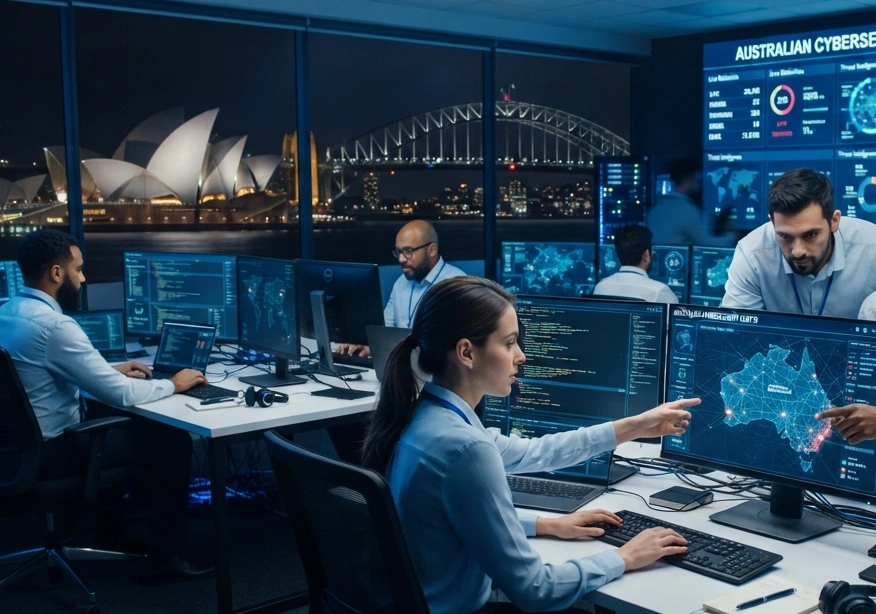
Managed cybersecurity services suit most small and mid-sized Australian businesses. They deliver 24/7 monitoring and specialist coverage at a lower cost than an in-house team. In-house security fits large enterprises with the budget for a dedicated five-plus person team.
The managed cybersecurity services market closed at $994 million last year and is projected to reach $3.1 billion by 2033. More and more businesses are choosing to outsource rather than build from scratch, and the broader cybersecurity services Australia landscape is moving with them.
The “which is better” question can only be answered basis your enterprise size, budget, and risk profile. If you’re comparing managed cybersecurity services against building an internal function, here’s what the decision comes down to.
Importance of Managed Cybersecurity Services
69% of Australian businesses reported a ransomware attack in the past 5 years. Out of these, almost 84% ended up paying. And the average ransom payment? It climbed to $1.35 million.
It is important to get your security operating model right the first time because attacks are more frequent and more expensive when they land. Discovering the gaps after an incident is an expensive way to learn them.
Managed Cybersecurity Services or In-House Security: Comparison
In-house security refers to hiring, training, and retaining a team of analyst, architect, and incident response teams. To enable it, enterprises have to manage and own the entire detection-to-response pipeline and all the tools that support it.
You control the roadmap and the people, but you also carry every cost and every coverage gap. Building a security operations center (SOC) internally comes with shift rosters, on-call rotations and tools licenses that run around the clock, whether an incident is happening.
On the other hand, having managed security services (also called outsourced cybersecurity or MDR services) means outsourcing a provider to deliver some or all that function. That money goes towards threat intelligence, continuous monitoring, incident response and compliance management, billed as a constant monthly cost.
Is Your Current Setup Giving You Real 24/7 Coverage?
Business-hours protection with an untested after-hours gap is more common than most businesses realize, and it’s usually the gap an incident finds first. Q3 Technologies can show you exactly where your coverage ends.
When To Choose In-house Security?
In-house security can work well, if you have:
- Budget for a dedicated team of 5 or more security specialists
- Deeply specific regulatory or data-residency requirements
- Scale to keep skilled staff busy
It is seen that large enterprises with mature IT functions blend in-house and managed cyber security services rather than pick one exclusively. This way the strategy and architecture stay internal, while round-the-clock coverage gets outsourced.
But there’s a catch – retention. Australia has cybersecurity talent shortage. It means in-house teams face constant recruitment pressure. Losing even one or two specialists can leave real gaps in coverage for months.
When To Choose Managed Cybersecurity Services?
Managed cybersecurity services is the better option for a majority of small and mid-sized enterprises in Australia. You get enterprise security services (continuous monitoring, threat detection, faster response) without carrying the cost of a 24/7 roster, ongoing training, and tooling licenses that a small internal team could never fully use.
The Australian MSSP market is also fragmented, with roughly 781 specialized providers active in the space. That means there is room to find a partner suited to your sector and size, rather than settling for whatever one-size-fits-all package is easiest to sell.
Also Read: The Latest Trends in Cybersecurity: How to Protect Your Business
Head-to-Head: What Each Model Actually Delivers?
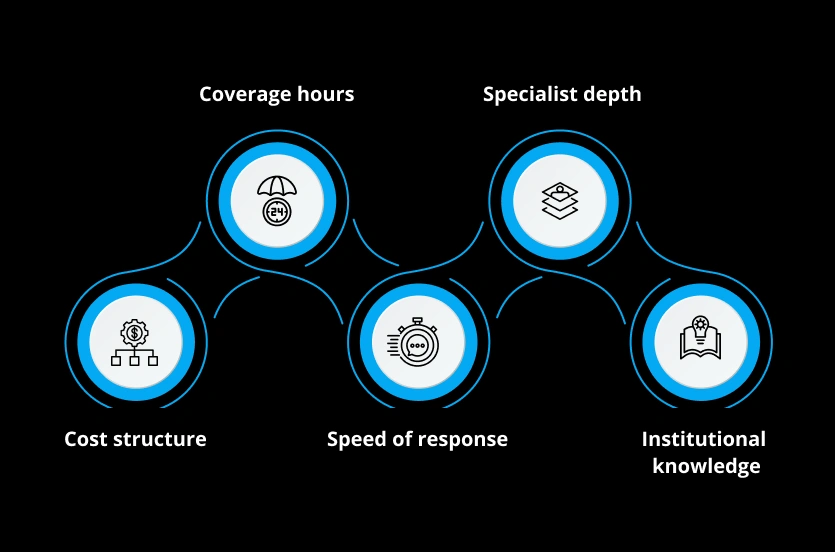
Cost structure
In-house security means fixed salary costs regardless of incident volume, plus tooling, training, and certification budgets. Managed cybersecurity services scale with your environment size, turning a large capital and hiring commitment into a predictable operating cost.
Coverage hours
A genuinely round-the-clock internal SOC monitoring function takes a minimum of four to six analysts across shifts, just to avoid single points of failure. An outsourced provider spreads that cost across many clients, which is how continuous coverage becomes affordable for a mid-sized business rather than a luxury reserved for large ones.
Speed of response
Outsourced cybersecurity providers built around MDR services are measured on response-time SLAs, often minutes rather than hours, because incident response is their core business. For an internal IT team, it’s one responsibility competing with nine others.
Specialist depth
No in-house team can economically staff deep specialists in every domain at once: cloud security management, network security services, threat intelligence, forensics. A managed provider spreads that specialist bench across its whole client base, so you’re borrowing depth you couldn’t justify hiring for full time.
Institutional knowledge
This is where in-house wins, and it matters more than people give it credit for. Your own team understands your systems, your business context, and your risk appetite in a way that takes any external partner months to build.
This is exactly the kind of gap Q3 Technologies closes. For one leading Managed IT Services Provider was facing issues with fragmented tools and manual assessments. They had no centralized way to track cyber risk maturity, prioritize fixes, or stay audit ready. Q3 Technology built CyberWatch. It is a security intelligence platform that combines risk scoring with real-time dashboards mapped to NIST CSF 2.0, automated remediation workflows, and dark web threat monitoring into a single view.
The result? They observed real-time risk visibility, stronger compliance readiness, and measurably fewer security gaps slip through unnoticed.
Cost Comparison Between In-house & Managed Cybersecurity Services
A single dedicated in-house security analyst in Australia typically costs more than AUD 120,000 annually in salary alone. This is before tooling, training, and the overhead of building shift coverage.
Whereas, managed provider covering equivalent monitoring and response often costs less than one senior analyst’s salary, while delivering broader specialist coverage and round-the-clock protection.
Note: Cost shouldn’t be the only lens, though. A business with highly sensitive, tightly regulated data may find the control and context of an in-house team worth the premium, even when the sticker price is higher.
Which Security Model Actually Fits Your Business?
The right answer depends on your size, risk, and budget, not a generic best practice. Q3 Technologies can help you map your current spend against your real coverage.
Where This Leaves You?
There’s no universal right answer here, just the answer that fits your risk profile, budget, and growth stage. What matters is making the decision deliberately, based on real coverage gaps and cost comparisons, instead of defaulting to whichever model your business happened to start with.
It’s also worth revisiting periodically: growth and regulatory change can shift the calculation within a couple of years, and a decision that was right before isn’t automatically right now.
FAQs
Is managed security better than in-house for Australian businesses?
Yes, for SMEs. Managed cybersecurity services deliver continuous monitoring and specialist coverage at a lower cost. However, for larger enterprises, a hybrid model is a better model.
Why businesses outsource cybersecurity?
To get benefits such as 24/7 monitoring, specialist threat intelligence and faster response. Plus, all of this is available without the cost and retention challenges of building a full internal security team.
Are there any benefits to managed security services?
Yes. Predictable operating costs, continuous security monitoring, faster response through MDR services, access to broader specialist expertise, and help with ongoing compliance management, are the most common benefits of MSSP.
Does MSSP or internal IT security handle compliance better?
In both cases, the responsibility for compliance is retained by your business. Although in the case of a mature MSSP, the service will normally include comprehensive audit-ready documentation and reporting that can reduce the internal compliance load.
What is the cost comparison between managed cybersecurity cost compared and an in-house team?
A single in-house security analyst in Australia often costs more than AUD 120,000 annually. While managed cybersecurity services offering equivalent monitoring and response costs less, while covering more specialist domains.

Table of content
- Importance of Managed Cybersecurity Services
- Managed Cybersecurity Services or In-House Security: Comparison
- When To Choose In-house Security?
- When To Choose Managed Cybersecurity Services?
- Head-to-Head: What Each Model Actually Delivers?
- Cost Comparison Between In-house & Managed Cybersecurity Services
- FAQs
Related Case Studies


Explore More

Cybersecurity
AI in Cybersecurity Projects: Real-World Examples

Cybersecurity