Chatbot
Rule-Based vs AI-Powered vs LLM Chatbots: What’s the Difference?


Quick Summary
Rule-based chatbots follow fixed scripts, while AI-powered chatbots understand customer intent using machine learning. LLM chatbots take it further with natural, human-like conversations and task automation. This blog compares all three, backed by market data, and explains how Q3 Technologies builds the right chatbot for your business.
Every business wants a chatbot today. But “chatbot” isn’t one technology anymore – it’s three very different technologies wearing the same name. Chatbot development has moved fast over the past few years, growing from simple decision-tree scripts into intelligent systems that can reason, remember context, and even take action on their own. Pick the wrong type and you get a frustrated customer, a wasted budget, and a bot nobody trusts. Pick the right one and you get faster support, lower costs, and customers who actually enjoy talking to your brand. In this guide, we break down rule-based, AI-powered, and LLM chatbots in plain English, back it up with credible numbers, and show you exactly how to choose – drawing on Q3 Technologies’ two decades of hands-on experience building bots that businesses actually rely on.
What is the Difference Between Rule-Based, AI-Powered, and LLM Chatbots?
At a glance, all three chatbot types sit inside the same chat window and answer the same customer questions. But how they arrive at that answer is completely different, and that difference decides how well your bot will actually perform once real customers start typing.
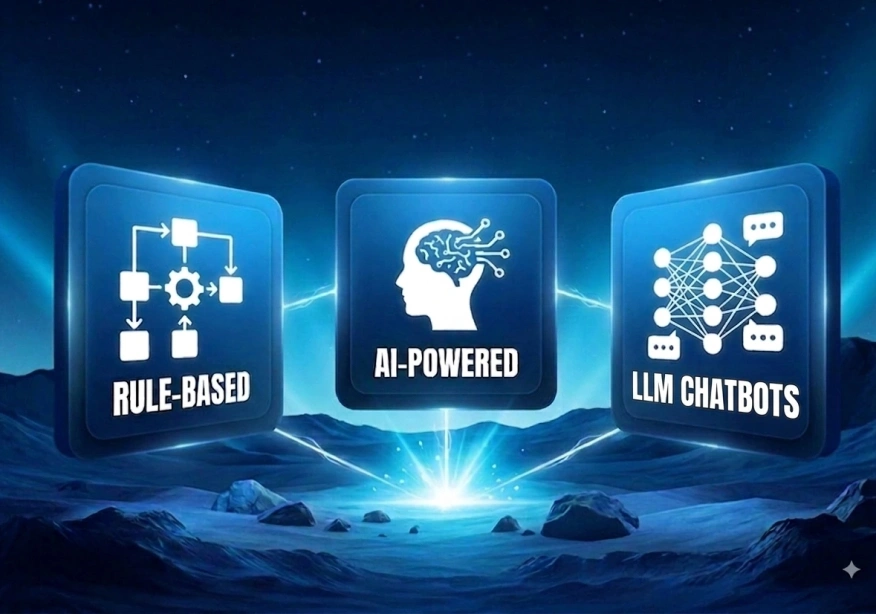
- Rule-based chatbots: Follow pre-written “if this, then that” logic trees. There is no real understanding here, just pattern matching against a fixed script.
- AI-powered chatbots: Use machine learning and natural language processing to detect what a user actually wants, even when the question is phrased a dozen different ways.
- LLM chatbots: Run on large language models trained on massive datasets, so they grasp context, tone, and nuance, and generate a fresh, human-sounding answer instead of picking from a fixed list.
The shift between these three is already visible in the market. Gartner-backed research shows AI-powered bots now make up roughly 68% of all chatbots deployed, up from around 40% just a few years ago, as businesses move away from rigid scripts toward smarter, model-driven systems.
What is a Rule-Based Chatbot and Where Does It Still Work Best?
A rule-based chatbot works off a decision tree. A customer clicks a button or types a known phrase, and the bot matches it to a pre-set answer, much like an IVR phone menu turned into text. There’s no learning involved and no real language understanding, but for the right use case, that’s not a weakness.
- Fast and cheap to build: No training data, no model tuning, and often live within days rather than weeks.
- Fully predictable: Every possible answer is pre-approved, which matters in regulated industries where an unscripted response is a real risk.
- Breaks on unexpected phrasing: One unfamiliar word or typo and the conversation stalls or loops.
- Never gets smarter: It performs the same after a thousand conversations as it did on day one.
Build the Right Chatbot for Your Business
From rule-based bots to advanced LLM solutions, Q3 Technologies can help you choose, build, and deploy the right chatbot.
What Makes an AI-Powered Chatbot Smarter Than a Rule-Based Bot?
AI-powered chatbots add natural language processing and intent recognition on top of the basic script. Instead of matching exact phrases, they understand what a customer means, pull out key details, and route the conversation intelligently.
- Understands intent, not just keywords: “Where’s my order” and “track my package” both trigger the same correct response.
- Improves with data: The more conversations it processes, the sharper its accuracy gets over time.
- Handles multiple use cases: Sales, support, and lead qualification can run through one bot instead of three separate scripts.
- Still has limits: Fully open-ended, creative, or highly complex questions can still trip it up.
Customer preference already backs this shift: 82% of consumers say they’d rather talk to a chatbot than wait for a human agent, but only when that bot can actually understand them.
How Do LLM Chatbots Redefine Conversational AI for Modern Businesses?
LLM chatbots are built on large language models, the same underlying technology behind tools like ChatGPT and Claude. Rather than retrieving a pre-written answer, they generate a new response for every message, drawing on context from earlier in the conversation. This is what true conversational AI looks like today: a system that remembers what you said three messages ago, adapts its tone, and can walk through multi-step questions the way a knowledgeable human agent would.
- Hold real conversations: They retain context across a long back-and-forth instead of resetting with every message.
- Generate original answers: Every reply is written fresh and shaped to the specific question, not pulled from a fixed script.
- Handle complexity: Multi-step questions, comparisons, and light reasoning are well within reach.
- Need careful guardrails: They cost more to run and require fine-tuning and monitoring to stay accurate and on-brand.
Rule-Based vs AI-Powered vs LLM Chatbots Explained: What’s the Real Difference in Results?
Numbers make the comparison easier to act on. Here’s how the three chatbot types stack up where it actually matters to a business owner.
- Setup time: Rule-based bots can launch in days; AI-powered bots typically take a few weeks; LLM chatbots need more time upfront for training, testing, and fine-tuning.
- Accuracy on complex queries: Rule-based bots score lowest, AI-powered bots sit in the middle, and LLM chatbots score highest, especially once fine-tuned on your own data.
- Cost per interaction: Industry benchmarks put an AI chatbot interaction at roughly $0.50 to $0.70, against $6 to $15 for a human-handled one, and that gap widens further as LLM-driven automation resolves even complex cases without escalation.
- Long-term ROI: LLM chatbots typically win here, because they cut escalations, keep improving, and reduce the need for constant script rewrites.
Here’s the same comparison laid out side by side, covering both the technical build and the real cost of each option:
| Aspect | Rule-Based Chatbot | AI-Powered Chatbot | LLM Chatbot |
|---|---|---|---|
| Underlying tech | Decision trees, if-then logic | NLP/NLU, machine learning models | Large language models (GPT, Claude class) |
| Language understanding | Keyword and phrase matching only | Detects intent and entities | Understands context, tone, and nuance |
| Conversation memory | None, each message is standalone | Limited, short-term context | Strong, multi-turn context retention |
| Typical build time | 1 to 3 weeks | 4 to 8 weeks | 8 to 14+ weeks, incl. fine-tuning |
| Integration complexity | Low, minimal backend work | Moderate, needs data pipelines | High, needs APIs, guardrails, RAG setup |
| Ongoing maintenance | Manual script updates | Periodic retraining on new data | Continuous fine-tuning and monitoring |
| Approx. development cost | $2,000 to $10,000 | $10,000 to $50,000 | $40,000 to $150,000+ |
| Cost per conversation | Near-zero, fixed scripts | Roughly $0.50 to $0.70 | Higher per token, offset by fewer escalations |
| Best fit | FAQs, order status, simple menus | Support, sales, lead qualification | Complex support, agentic workflows, premium CX |
Cost ranges are indicative industry estimates for mid-sized business deployments and vary by scope, integrations, and vendor. Use them as a starting benchmark, not a fixed quote.
Which Chatbot is Best for Business?
There’s no single “best” chatbot for every business. The right choice depends on your query volume, budget, and how complex your customer conversations actually get.
- Choose rule-based if: your queries are simple, repetitive, and your budget is tight – think store hours, order status, or basic FAQs.
- Choose AI-powered if: you need broader intent coverage across support, sales, and marketing, and phrasing varies a lot.
- Choose an LLM chatbot if: you want natural conversations, complex query handling, and a system that keeps getting smarter over time.
- Still unsure? A short discovery call with an experienced team can map your query volume and complexity to the right model before you spend a rupee on development.
Why is Chatbot Automation the Next Big Priority for Enterprises?
Nearly 88% of organizations now use AI in at least one business function, and contact centers are leading the charge, with Gartner projecting $80 billion in cumulative labor cost savings from conversational automation by the end of 2026. Chatbot automation has gone from a nice-to-have to a competitive necessity.
- Round-the-clock coverage: A well-built enterprise chatbot never clocks out, across time zones, weekends, and holidays.
- Lower cost per ticket: Automating routine, repetitive queries cuts support costs significantly while keeping service quality high.
- Faster resolution: Reduces average handling time and keeps customers from waiting in a queue.
- Data-rich insights: Every automated conversation becomes a data point that helps improve products, policies, and future bot training.
Curious how larger organizations are using automation at scale? Our guide on enterprise chatbot use cases and implementation breaks down real deployment patterns across industries.
Why Do Growing Businesses Need Domain-Specific LLM Fine-Tuning?
A general-purpose LLM knows a little about everything, but not much about your specific products, policies, or tone of voice. That gap is exactly what domain-specific LLM fine-tuning solves – training a model on your own catalog, support history, and compliance documents so it gives accurate, on-brand answers instead of generic, one-size-fits-all responses.
- Accuracy on your data: Fewer generic or hallucinated answers about your own products, pricing, or policies.
- Consistent brand voice: The bot always sounds like your company, not a generic assistant borrowed from the internet.
- Built-in compliance: Fine-tuned models can be trained to strictly follow industry regulations, which matters most in finance, healthcare, and insurance.
Take Your Chatbot Beyond Conversations
Transform customer interactions with AI-powered, domain-specific, and agentic chatbot solutions from Q3 Technologies.
How Does Agentic AI Development Take Chatbots Beyond Simple Conversation?
The newest frontier isn’t just talking, it’s doing. Agentic AI development gives a chatbot the ability to take real action inside your business systems, not just describe what could be done.
- Takes real actions: Books an appointment, raises a support ticket, or updates a CRM record, instead of just describing the steps.
- Chains tasks together: Completes multi-step workflows end to end without handing off to a human midway.
- Connects to your tools: Uses APIs and integrations to pull live data and push updates back into your existing systems.
For a deeper look at how this compares to a traditional bot, see our breakdown of AI agents vs chatbots, including where each one fits bes
How Did Q3 Technologies Help an Australian Hospitality Client Move Beyond a Basic Chatbot?
A hospitality client came to Q3 Technologies with a common problem: their old rule-based booking widget could only handle a handful of fixed commands, and guests kept abandoning the chat whenever a question fell outside its script. Our team designed and built a smarter Virtual Booking Assistant using the Microsoft Bot Framework and ASP.NET development, layering in natural language understanding so guests could book rooms, check amenities, view special offers, and apply discount coupons in a single, flowing conversation.
- User authentication: Guests could sign in, sign up, or continue as a guest, with the bot personalizing responses based on saved preferences and membership tier.
- Backend integration: A direct connection to the client’s CMS meant new hotels and offers could be added without touching the bot’s core logic.
- Result: Booking-related conversations that previously stalled on unrecognized phrasing were resolved in a single continuous chat, cutting abandoned sessions and lifting direct bookings.
You can read more about how chatbot technology has evolved to make projects like this possible in our piece on the evolution of chatbots.
Why Choose Q3 Technologies for Your Next Chatbot Project?
Choosing between rule-based, AI-powered, and LLM chatbots isn’t a decision you should make alone, and it isn’t one you should make without a partner who has actually shipped all three at enterprise scale.
- End-to-end chatbot development services: From discovery to deployment, our chatbot development services cover strategy, design, build, testing, and ongoing support under one roof.
- Model expertise across the board: Whether you need a simple rule-based assistant or a fully custom build, our LLM development services cover advanced use cases involving reasoning, memory, and multi-turn dialogue.
- Consulting before code: Our AI strategy and consulting team starts every engagement with a discovery workshop to map your query volume, budget, and complexity to the right chatbot type.
- Proven delivery: 200+ AI-powered projects delivered across healthcare, retail, manufacturing, fintech, and hospitality, backed by ISO 27001 and CMMI Level 3 credentials.
Whatever stage you’re at – replacing a tired rule-based bot, upgrading to AI-powered intent recognition, or building a fully custom LLM assistant – Q3 Technologies has the engineering depth to get it right the first time.
Ready to Build a Smarter Chatbot?
Partner with Q3 Technologies to design, develop, fine-tune, and scale a chatbot built around your business needs.
Conclusion
Rule-based bots are cheap and predictable but limited. AI-powered bots understand intent and scale better. LLM chatbots deliver the most natural, capable conversations and the strongest long-term ROI, especially once fine-tuned on your own data. The right pick depends on your budget, your query complexity, and how far you want automation to go. If you’re ready to figure out exactly which chatbot fits your business, Q3 Technologies is ready to help you build it.
FAQs
Which chatbot is best for business: AI-powered or LLM?
It depends on query complexity. AI-powered chatbots suit predictable, high-volume interactions – order tracking, appointment booking, lead qualification – where scripted paths keep answers consistent. LLM chatbots suit open-ended support, knowledge-heavy queries, and long conversations where users phrase the same problem a dozen ways. Many enterprises deploy both: a structured layer for transactions, an LLM layer for everything else.
How does RAG improve LLM chatbot accuracy?
Retrieval-Augmented Generation connects an LLM chatbot to trusted business data – product documentation, policy libraries, knowledge bases – so it retrieves relevant source material before generating an answer. This grounds responses in current, verifiable information instead of the model’s training data, reducing outdated and unsupported answers.
What is domain-specific LLM fine-tuning for chatbots?
Fine-tuning retrains a base model on a company’s own examples so it learns industry terminology, tone, and response patterns. It differs from RAG: fine-tuning changes how the model writes, while RAG changes what information it draws on. Most enterprise chatbots use RAG for accuracy and fine-tuning for consistency of voice.
Can LLM chatbots integrate with enterprise systems?
Yes. LLM chatbots connect to CRMs, ERPs, ticketing platforms, and databases through REST APIs, webhooks, and middleware connectors. This lets the chatbot pull live records – order status, ticket history, account details – into a conversation, and write back to those systems when a user completes an action.
What is the role of Agentic AI in chatbot development?
Agentic AI enables chatbots to plan and execute multi-step tasks rather than only answering questions. An agentic chatbot can book an appointment, raise a support ticket, update a CRM record, or chain several of these together – deciding which tools to call and in what order to complete the request.
How do you prevent an LLM chatbot from hallucinating?
Through layered controls rather than a single fix. RAG grounds answers in verified source data. Confidence thresholds route uncertain queries to a human. Response validation checks output against retrieved sources before it reaches the user. Guardrails restrict the chatbot to approved topics, and citation of source documents lets users verify answers themselves.
Is enterprise data secure when using an LLM chatbot?
It depends on the architecture. Risk concentrates in three places: what data leaves your environment, how it is stored, and who can access retrieved records. We build chatbot solutions under ISO 27001-certified information security practices, with role-based access controls, encrypted data handling, and deployment options that keep sensitive data inside your own infrastructure.
How long does it take to deploy an LLM chatbot?
Timelines depend on four variables: the number of systems being integrated, the state of your knowledge base, whether fine-tuning is required, and the compliance review your industry demands. A RAG chatbot over existing documentation moves faster than an agentic system with write access to your CRM. Our CMMI Level 3 delivery process defines each phase upfront so scope and timeline are agreed before development begins.

Table of content
- What is the Difference Between Rule-Based, AI-Powered, and LLM Chatbots?
- What is a Rule-Based Chatbot and Where Does It Still Work Best?
- What Makes an AI-Powered Chatbot Smarter Than a Rule-Based Bot?
- How Do LLM Chatbots Redefine Conversational AI for Modern Businesses?
- Rule-Based vs AI-Powered vs LLM Chatbots Explained: What’s the Real Difference in Results?
- Which Chatbot is Best for Business?
- Why is Chatbot Automation the Next Big Priority for Enterprises?
- Why Do Growing Businesses Need Domain-Specific LLM Fine-Tuning?
- How Does Agentic AI Development Take Chatbots Beyond Simple Conversation?
- How Did Q3 Technologies Help an Australian Hospitality Client Move Beyond a Basic Chatbot?
- Why Choose Q3 Technologies for Your Next Chatbot Project?
- FAQs
Related Case Studies