Software Development
Software Development Life Cycle (SDLC): Phases & Process


Summary
This blog explains the Software Development Life Cycle (SDLC), covering its seven key phases, popular development methodologies, and best practices for successful software delivery. It also explores how testing, DevOps, custom development, and expert consulting help reduce risks and build scalable, production-ready software.
At Q3 Technologies, we have spent more than 25 years working inside the software development life cycle — shipping mobile apps, enterprise platforms, and AI-driven systems for clients across the USA, UK, India, Australia, and the UAE. If you want a plain-English answer on how software actually gets built, you are in the right place. This guide walks through every phase, the process that ties them together, the methodologies teams choose from, and how the right technology partner turns a rough idea into a production-ready product. We will also share what we have learned first-hand from more than 2,000 delivered projects, along with a real case study, so you can see the SDLC in action rather than just read about it in theory.
What is the Software Development Life Cycle?
In simple terms, SDLC is the step-by-step roadmap a software team follows to plan, build, test, launch, and support an application. Think of it the way you would think about building a house — you do not pour concrete before you have a blueprint, and you do not hand over the keys before an inspector checks the wiring. The SDLC brings that same discipline to code. It gives developers, testers, project managers, and business stakeholders a shared map, so nobody is left guessing what comes next. Skip this structure and a project quickly turns into rushed code, missed requirements, and expensive rework. Follow it properly and you get predictable timelines, cleaner budgets, and software that genuinely solves the problem it was built for. In our own delivery rooms, this is the difference between a release that ships on a Friday with confidence and one that keeps everyone on call all weekend.
How Does the SDLC Process Work?
At its core, the software development life cycle process moves information forward stage by stage. Each phase takes the output of the one before it — a requirement becomes a design, a design becomes code, code becomes a tested build, and a tested build becomes a live product. Depending on the methodology a team chooses, these stages can run one after another, or they can loop continuously in short cycles. Either way, the process is never just about writing code. It is about capturing what users truly need, designing something technically sound, building it with discipline, proving it works through rigorous testing, releasing it safely, and supporting it for as long as the business needs it. When any single step is rushed, the cost of fixing the problem later multiplies fast, which is exactly why our engineering leads insist on treating every phase as equally important.
What Are the 7 Phases of SDLC?
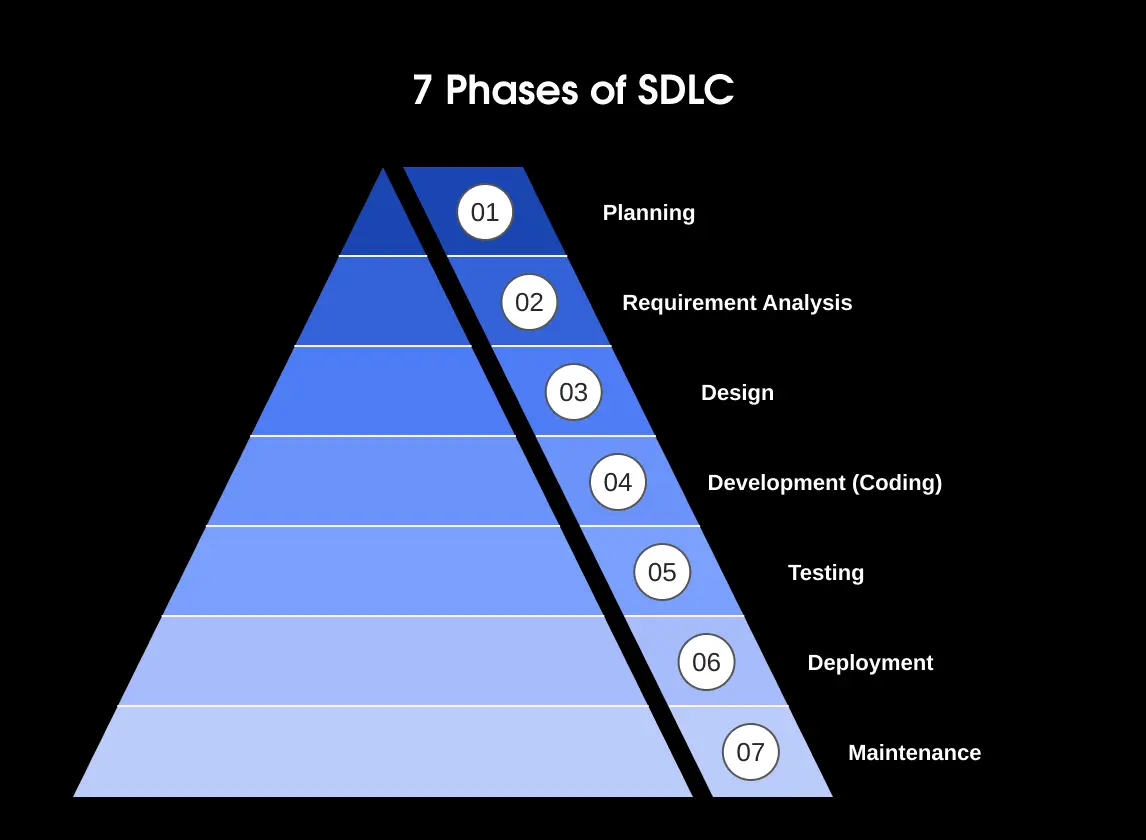
Most engineering teams, ours included, organize the software development life cycle phases into seven stages. Here is what each one actually involves in a real project, not just on paper:
- Planning: The team defines the project’s goals, budget, timeline, and success metrics, so everyone agrees on what “done” actually looks like before a single line of code is written.
- Requirement Analysis: Business analysts and stakeholders document functional and non-functional needs in detail, turning vague business goals into a clear specification developers can build against.
- Design: Architects map out system architecture, database structure, integrations, and UI/UX flows, producing a blueprint that reduces guesswork once coding begins.
- Development (Coding): Developers write, review, and version the actual code, following the design document and coding standards to keep the build maintainable long after launch.
- Testing: QA engineers run unit, integration, system, security, and user-acceptance testing to catch defects before customers ever see them.
- Deployment: The finished build is released to production, often in a phased or beta rollout, with monitoring in place to catch issues early.
- Maintenance: Post-launch, teams patch bugs, apply security updates, and add enhancements so the software keeps pace with changing user and business needs.
Ready to Build Better Software?
Let us help you plan, develop, test, and deploy scalable software solutions.
Which Development Approach Should Your Team Follow?
Choosing the right SDLC methodologies shapes how fast, and how safely, software reaches the market. These are the approaches we most often recommend to clients, depending on project size and how likely requirements are to change:
- Waterfall: A linear model where each phase finishes before the next begins — best for projects with fixed, well-understood requirements.
- Agile: Work is delivered in short sprints with constant feedback, which is why our team wrote a detailed breakdown in Agile Software Development Process, Benefits & Best Practices if you want to go deeper.
- Scrum and Kanban: Two popular Agile frameworks — Scrum organizes work into time-boxed sprints, while Kanban visualizes continuous flow on a board.
- DevOps: Development and operations merge into one continuous pipeline, using automation to ship updates faster and more reliably.
- Spiral Model: Risk analysis is repeated across cycles, making it a strong fit for large, high-risk, or highly regulated projects.
- V-Model: Every development phase is paired with a matching testing phase, which suits projects that demand heavy verification, such as banking or healthcare systems.
What Should a Complete Software Delivery Engagement Include?
When you hire a partner for software development life cycle services, you should expect far more than programmers typing code. A complete engagement, the way we run it at Q3 Technologies, typically covers:
- Discovery and requirement workshops to translate business goals into a technical roadmap before any commitment is made.
- Solution architecture and UX design that plans for scale, security, and a genuinely usable interface from day one.
- Full-stack development across web, mobile, and cloud, using the technology stack that actually fits the problem rather than the latest trend.
- Automated and manual quality assurance built into every sprint instead of bolted on at the end.
- Cloud deployment and release management with minimal downtime and a rollback plan ready if anything goes wrong.
- Ongoing maintenance and optimization so the software keeps performing well long after go-live.
Why Bring in Outside Experts for a Complex Build?
Not every in-house team has the bandwidth, or the specialized experience, to run a complex build end to end — and that is exactly where SDLC consulting services earn their value. An experienced consulting partner helps you pick the right methodology, right-size your budget, and avoid the expensive detours that come from guessing. This is not a small concern: independent research on software engineering costs found that testing alone can consume close to a third of total system development spend when it is bolted on late instead of built into every phase, and industry surveys show more than a third of organizations already lean on AI tools to speed up parts of the development lifecycle, a share that keeps climbing every year. Bringing in consultants early is usually far cheaper than fixing scope, security, or performance problems after launch.
Why Does Building Custom Beat Buying Off-the-Shelf?
Off-the-shelf tools rarely match every workflow perfectly, which is why custom software development solutions remain the backbone of most serious SDLC engagements. A purpose-built application fits your existing processes instead of forcing your team to work around someone else’s assumptions, and it scales the way your business actually grows rather than the way a generic license was packaged. We have seen this play out directly — when we helped an education client build a platform from the ground up, we documented the approach in Building a School Management System: The Ultimate Guide, which shows how custom-built software can outperform a rigid, one-size-fits-all product.
Need Expert SDLC Support?
Connect with our team for end-to-end software development and SDLC consulting services.
How Does Testing Reduce Risk at Every Stage?
software testing services are not a single checkpoint before launch — they are a safety net woven through every phase of the SDLC. Continuous testing catches functional bugs, security gaps, and performance bottlenecks while they are still cheap to fix, instead of after customers have already found them. Automated regression suites, manual exploratory testing, and dedicated security testing together give stakeholders real confidence that a release is actually ready, not just finished. Teams that treat testing as an afterthought routinely pay for it later in the form of production outages, security incidents, and frustrated users.
How Does Merging Dev and Ops Speed Up Delivery?
Modern teams no longer treat coding and operations as two separate worlds. DevOps consulting services merge them so that SDLC software development becomes a continuous pipeline instead of a handoff race between departments. Continuous integration and continuous delivery (CI/CD) pipelines mean code is tested and deployed in small, frequent batches instead of one risky, giant release. This shrinks the gap between writing code and learning whether it actually works in production, which is often the single biggest lever for shipping faster without sacrificing quality. If your organization is weighing whether to build this capability in-house or bring in outside help, our breakdown of Staff Augmentation vs. Managed Services vs. Project Outsourcing: Picking the Right Model walks through the trade-offs.
How Did Q3 Technologies Apply the SDLC to a Real-World Project?
Theory is easy to write about — delivery is where it gets tested. For a leading transport services provider, our team ran a full SDLC engagement to unify fragmented railway operations into a single, streamlined application. We started with discovery workshops to map the operational pain points, moved through architecture and UX design for a system multiple user groups would rely on daily, built and tested the platform in iterative cycles, and rolled it out with a deployment plan built for zero disruption to live operations. The result was a modernized, unified app solution that improved efficiency across the client’s railway network.
You can read the full breakdown here: Revolutionizing Railway Operations with a Unified App Solution for a Leading Transport Services Provider.
Why Should You Choose Q3 Technologies for Your Next SDLC Project?
Choosing where you get your software development life cycle (SDLC) services matters just as much as choosing the right methodology. Here is what sets our team apart:
- 25+ years of delivery experience: We have run the full software development life cycle for enterprises across five continents, so we have already seen the mistakes worth avoiding.
- 2,000+ projects delivered: Our teams have shipped everything from mobile apps to AI-driven platforms, giving us pattern recognition that shortens your learning curve.
- Certified and trusted: We are ISO 27001 and ISO 9001:2015 certified, a Microsoft Solutions Partner for Azure AI and Cloud, and a Salesforce Certified Partner.
- Full-stack capability under one roof: Planning, design, development, testing, DevOps, and managed IT support all sit within one accountable team instead of being split across vendors.
- Global delivery model: With teams across Asia, North America, Europe, and Australia, we combine onshore and offshore delivery for faster turnaround without a loss of quality.
- Industry-specific expertise: From banking and healthcare to logistics, education, and manufacturing, we bring domain knowledge, not just generic engineering.
Turn Your Software Idea into Reality
Partner with our experts to build a secure, scalable, and production-ready solution tailored to your business.
Ready to Start Your Own SDLC Journey?
Whether you need a single phase of support or a full end-to-end build, Q3 Technologies is ready to help you plan, design, build, test, and scale your next application with confidence. Visit Q3 Technologies to explore our full range of services, or talk to our experts directly to discuss your project — there is no obligation, and most requests get a response within four business hours.
FAQs
1. How is AI changing the Software Development Life Cycle (SDLC)?
AI is automating tasks such as code generation, testing, debugging, documentation, and requirements analysis. AI-assisted development can help teams accelerate delivery while maintaining human oversight for architecture, security, and quality.
2. What is the role of DevSecOps in the SDLC?
DevSecOps integrates security practices into every SDLC phase rather than treating security as a final checkpoint. It uses automated security testing, vulnerability scanning, compliance checks, and continuous monitoring to identify risks earlier.
3. How does CI/CD improve the SDLC process?
CI/CD automates code integration, testing, and deployment, allowing teams to release smaller changes more frequently. This reduces manual errors, shortens feedback cycles, and makes software releases more predictable.
4. What is shift-left testing in the SDLC?
Shift-left testing moves testing activities earlier in the development process. Developers and QA teams can identify defects, security vulnerabilities, and performance issues before they reach later stages or production.
5. How can organizations integrate Generative AI into the SDLC securely?
Organizations should establish governance around AI-generated code, protect sensitive data, validate outputs through testing and code reviews, and use approved AI tools. Human review remains important for security, compliance, architecture, and production code.
6. How do cloud-native technologies affect modern SDLC practices?
Cloud-native development uses technologies such as containers, Kubernetes, microservices, serverless computing, and infrastructure as code to improve scalability and deployment flexibility. Combined with CI/CD and observability, these technologies support faster and more resilient software delivery.

Table of content
- What is the Software Development Life Cycle?
- How Does the SDLC Process Work?
- What Are the 7 Phases of SDLC?
- Which Development Approach Should Your Team Follow?
- What Should a Complete Software Delivery Engagement Include?
- Why Bring in Outside Experts for a Complex Build?
- Why Does Building Custom Beat Buying Off-the-Shelf?
- How Does Testing Reduce Risk at Every Stage?
- How Does Merging Dev and Ops Speed Up Delivery?
- How Did Q3 Technologies Apply the SDLC to a Real-World Project?
- Why Should You Choose Q3 Technologies for Your Next SDLC Project?
- FAQs
Related Case Studies


Explore More

Software Development
Custom Software Development Process: Key Steps Before You Build

Software Development
15 Must-Have Features of Facilities Management Software in 2026
Software Development