Software Development
Custom Software Development Process: Key Steps Before You Build



Summary
Building successful software starts with the right planning. This guide covers the custom software development process—from discovery and UI/UX design to Agile development, testing, deployment, and support—showing how a structured SDLC helps reduce risks, control costs, and deliver scalable business solutions.
Here’s an uncomfortable number: close to 40 percent of software projects fail to fully deliver on their original goals, and poor or mismanaged requirements are cited as the single biggest reason why, showing up in roughly a third to four out of every ten failed builds. On top of that, nearly 78 percent of projects experience scope creep, and 40 to 50 percent are delivered later than originally scheduled. Businesses get excited about the finish line — the sleek app, the automated dashboard, the customer self-service portal — and rush past the groundwork that actually makes those things work.
None of that has to be your story. Every one of these outcomes traces back to a handful of decisions made in the first few weeks of a project, long before anyone starts writing code. Get those early decisions right, and the rest of the build tends to go smoothly. Get them wrong, and no amount of talented engineering can fully make up for it later.
That groundwork is not red tape. It is the difference between a product that ships on schedule and one that quietly eats your budget twice over. This blog breaks down every move that needs to happen before a developer opens a code editor, and shows why the right partner in enterprise software development turns that groundwork into a real competitive edge, not a bottleneck.
What is That Repeatable Path from Idea to Launch Actually Called?
Every app, portal, or platform you have ever used followed a repeatable path known as the software development lifecycle — the sequence of stages a product moves through, from idea to launch to ongoing support. Think of it as the flight plan a pilot files before takeoff. Skip it, and you are flying blind, hoping the runway shows up on time.
If you want the software development lifecycle explained in plain terms, here it is: plan, design, build, test, launch, support. Each stage feeds directly into the next one. Miss a stage, or rush through it to save a week on the calendar, and the mistake does not disappear. It resurfaces later, usually bigger, pricier, and far harder to undo than it would have been at the start.
Plan Your Custom Software Project with Confidence
From discovery to deployment, Q3 Technologies helps you build scalable, high-performance software tailored to your business goals.
What Are the Steps to Develop Custom Software Development Process Before You Build Anything?
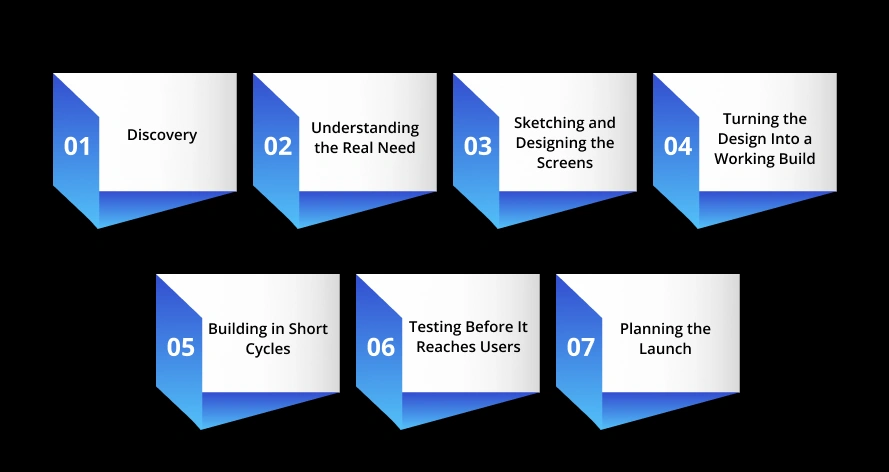
This is where the real work happens. Below are the moves smart teams make before development ramps up, plus the ones that carry a project all the way through to a confident launch.
1. Discovery
Your team and your development partner sit down to define the business problem, the target users, the budget, and a realistic timeline. Good software planning turns a vague idea — “we need an app” — into a scoped, fundable project with clear, written success criteria that everyone signs off on before work begins.
2. Understanding the Real Need
This is the detailed-interview stage — workshops, stakeholder calls, and process mapping to capture exactly what the software must do, for whom, and under what constraints. Thorough requirement gathering catches contradictions and gaps early, when they cost a conversation instead of a rebuild, and it is the single step most closely tied to whether a project succeeds or stalls.
3. Sketching and Designing the Screens
Before a single screen is coded, designers sketch the skeleton of the product. Wireframing maps out where buttons, forms, and navigation live, so your team can test the flow on paper long before it becomes expensive, hard-to-change code. This step flows directly into full UI/UX design, where color, typography, spacing, and interaction patterns are layered on top of that skeleton. Forrester research found that every dollar spent on strong UX design returns close to one hundred dollars in value through higher conversions and lower rework, so this stage is never just cosmetic polish — it is where a large share of your future revenue gets decided.
4. Turning the Design Into a Working Build
With requirements locked and screens designed, the project enters a structured custom software development process — architecture decisions, technology stack selection, and the very first working build. Many teams begin this stage with MVP development: a lean, functional first version built to test the core idea with real users before the full platform is funded. Startups that take this approach report success rates around 60 percent higher than teams that launch fully built products with no validation step, since a working prototype tells you far more than a slide deck ever could. Solid software project planning ties every one of these stages together with named owners, dates, and budget checkpoints, so nothing falls through the cracks.
5. Building in Short Cycles
Rather than disappearing for months, modern teams use agile software development — short, two-week sprints, each ending with a working demo. You see real progress every two weeks, and you can redirect the build early if priorities shift, instead of finding out something is wrong on delivery day. This working rhythm also keeps your budget predictable, since cost overruns get caught sprint by sprint rather than at the very end.
6. Testing Before It Reaches Users
Every sprint should ship with automated tests attached. Before launch, the product goes through full quality assurance — functional testing, performance testing, accessibility checks, and security testing — because catching a bug before launch is far cheaper, and far less embarrassing, than fixing it in front of real customers.
7. Planning the Launch
Launch day needs a plan of its own. A smart deployment strategy, such as a phased or zero-downtime rollout, protects your users and your uptime the moment the software goes live, and gives your team a clean rollback path if something needs a second look before it reaches everyone.
Also Read: How to Choose a Custom Software Development Company
What Does This Look Like When You Zoom Out and See the Whole Lifecycle?
Zoom out, and everything above maps cleanly onto the classic SDLC phases: discovery, design, development, testing, deployment, and support. Understanding the process of custom software development process matters because it tells you exactly what to ask a vendor. If a partner cannot clearly show you what happens in each phase, who signs off, and what you get at the end of it, treat that as a warning sign worth taking seriously.
The numbers back this structure up. According to the Standish Group’s 2024 CHAOS research, agile-run projects succeed at a rate of 64 percent, compared with 49 percent for traditional waterfall projects — and the gap widens further on large, complex builds. Structure and iteration, working together, consistently outperform either one alone. This is also why serious custom software development partners rarely offer a single fixed methodology for every client. The right mix of phases, sprint lengths, and sign-off checkpoints should flex to match your industry, your compliance needs, and how much risk you are willing to carry.
Turn Your Software Idea into a Market-Ready Solution
Whether you’re building an MVP or a full-scale enterprise platform, our end-to-end software development services ensure faster delivery and long-term success.
Why Bring in an Outside Technology Partner Instead of Going It Alone?
Most internal teams are excellent at running the business — not at architecting scalable systems, securing enterprise-grade data, or managing a six-figure technology build. That is exactly the gap a software consulting partner is built to close, and why so many otherwise capable companies still choose to bring in outside expertise for a serious build.
- Objective technical guidance: A senior architect reviews your idea before a single hour is billed, and tells you honestly when a smaller, cheaper solution will do the job just as well.
- Access to a full bench of expertise: You get researchers, designers, developers, QA engineers, and DevOps specialists working together, without hiring and managing each one yourself.
- End-to-end coverage under one roof: Full-spectrum software development services — planning, design, development, testing, deployment, and post-launch support — move through one accountable partner instead of a patchwork of freelancers and vendors.
How Did Structured Planning Pay Off for a Real Q3 Technologies Client?
Q3 Technologies partnered with a leading transport services provider to replace fragmented, legacy ticketing and operations tools with a single, unified railway operations application. The engagement followed the exact path outlined in this guide: discovery workshops with frontline staff, structured requirement sessions across multiple departments, wireframed flows for both passenger-facing and internal-operations screens, and a phased first release before the full rollout. Two-week sprints kept every stakeholder in the loop, and a carefully phased go-live protected an operation that runs around the clock.
The result was a unified application that replaced siloed legacy systems with one scalable platform built for the way the transport provider actually works. It is a clear, real-world example of what disciplined groundwork can achieve when it is followed all the way through to launch and long-term support.
“Revolutionizing Railway Operations with a Unified App Solution for a Leading Transport Services Provider.” — Source: Q3 Technologies case study
The lesson generalizes well beyond railways. Whether the industry is healthcare, banking, retail, or logistics, the same pattern shows up again and again: the projects that hit their launch date and their budget are the ones where discovery, design, and testing were treated as real work, not paperwork to rush through on the way to writing code.
Why Should You Choose Q3 Technologies for Your Next Build?
Choosing a technology partner is a long-term decision, not a one-time purchase order. Here is what enterprise clients across 21 countries point to when they explain why they stayed with Q3 Technologies for years, not just for one project:
- 25+ years of engineering experience: Software delivered for global brands across BFSI, healthcare, retail, manufacturing, logistics, telecom, and education.
- Engineering-led, not sales-led: Every engagement opens with a senior architect, not an account manager, so you get honest technical advice from day one.
- Global delivery, local accountability: Eight delivery hubs spanning India, North America, Europe, Australia, and the Middle East, with on-shore stakeholder access.
- Certified and audit-ready: CMMI process maturity, ISO 27001 certification, and Microsoft Solutions Partner status, with security built into the architecture from day one, not bolted on after launch.
- Flexible engagement models: Fixed-bid, time-and-materials, or dedicated teams — built around your risk appetite and your roadmap, not a one-size-fits-all contract.
- A true long-term partner: SLA-backed support, quarterly roadmap reviews, and proactive security patching, trusted by names like Samsung, Vedanta, Panasonic, and Hero MotoCorp.
Build Smarter with Q3 Technologies
Reduce development risks, accelerate delivery, and create future-ready software with our proven development process and engineering expertise.
Expert Advice
Great software is never an accident. It is the product of disciplined planning, honest fact-finding with the people who will actually use it, thoughtful design, and a team that treats testing and launch day as seriously as the very first line of code. Whether you are validating a first idea or modernizing a mission-critical platform, the steps in this guide are the same ones Q3 Technologies runs on every single engagement. Talk to our experts today and find out what disciplined groundwork can do for your next build.
FAQs
Why should I choose Q3 Technologies for custom software development?
Q3 Technologies combines 25+ years of engineering expertise with a structured software development process to deliver secure, scalable, and business-focused solutions. From discovery and UI/UX design to development, testing, deployment, and ongoing support, our teams ensure every solution is aligned with your business goals and built for long-term growth.
How does Q3 Technologies ensure a successful software development process?
We follow a proven Software Development Lifecycle (SDLC) that includes discovery, requirement gathering, architecture planning, UI/UX design, Agile development, quality assurance, deployment, and post-launch support. This structured approach minimizes project risks, improves transparency, and accelerates time to market.
Can Q3 Technologies build an MVP before developing a full-scale product?
Yes. We help businesses validate ideas quickly through Minimum Viable Product (MVP) development. By launching a feature-rich yet lean solution first, organizations can gather real user feedback, reduce development risks, and make informed investment decisions before scaling.
What industries does Q3 Technologies serve with custom software development?
Q3 Technologies develops custom software solutions for industries including healthcare, banking and financial services, retail and eCommerce, manufacturing, logistics, education, telecommunications, and more. Our solutions are tailored to meet industry-specific operational and compliance requirements.
Does Q3 Technologies provide support after software deployment?
Absolutely. Our engagement doesn’t end at launch. We offer post-deployment maintenance, performance monitoring, security updates, feature enhancements, and ongoing technical support to keep your software secure, reliable, and future-ready.
How do I get started with Q3 Technologies for a custom software project?
Getting started is simple. Our experts begin with a discovery session to understand your business objectives, technical requirements, timeline, and budget. Based on these insights, we recommend the right technology stack, development approach, and roadmap to deliver a scalable custom software solution.

Table of content
- What is That Repeatable Path from Idea to Launch Actually Called?
- What Are the Steps to Develop Custom Software Before You Build Anything?
- What Does This Look Like When You Zoom Out and See the Whole Lifecycle?
- Why Bring in an Outside Technology Partner Instead of Going It Alone?
- How Did Structured Planning Pay Off for a Real Q3 Technologies Client?
- Why Should You Choose Q3 Technologies for Your Next Build?
- FAQs
Related Case Studies


Explore More

Software Development
Top Custom Software Development Trends in Australia for 2026

Software Development
How to Choose a Custom Software Development Company

Software Development