Software Development
How to Choose a Custom Software Development Company



Summary
Picking the wrong technology partner can cost you months and thousands of dollars. This guide draws on primary market research and our own project-delivery experience to walk you through exactly how to vet, question, and choose a partner who can turn your idea into a product people actually use — including a ready-to-use vetting checklist, realistic cost ranges, sourced industry statistics, and an honest look at where Q3 Technologies fits into that decision.
Here is a number worth pausing on: the global custom software market is projected to grow from $53.95 billion in 2025 to $65.85 billion in 2026, and is on track to reach $141.13 billion by 2030, according to The Business Research Company’s 2026 market report. That is not a niche trend — it is a rapidly expanding market that startups and Fortune 500 enterprises alike are competing to capture.
More demand also means more vendors, and vendor quality varies widely. Industry-wide project data compiled by the Standish Group’s Chaos Report (as summarized in RaftLabs’ 2026 custom software statistics review) indicates that roughly 40% of software projects fail to meet their original goals, and a further 52% run late, over budget, or ship with reduced functionality. Put simply, only a minority of projects fully succeed — and the deciding factor is almost always who you choose to build the product.
This guide sets out, in plain and practical terms, how to evaluate and choose a custom software development company you can trust — supported by cited market data, a step-by-step vetting process, and transparent cost benchmarks you can use in your own vendor conversations.
What is Custom Software Development, and Why Does it Matter?
Off-the-shelf software is built for a broad market, which means it is optimized for no one business in particular. Custom software development is the practice of designing, building, and maintaining applications around a specific organization’s workflows, customers, and growth plans, rather than asking the business to adapt to a generic tool.
This is one reason enterprise software now accounts for an estimated 61% of the custom development market’s revenue share, according to Precedence Research’s 2026 market analysis. Larger organizations increasingly find that generic tools cap their operational flexibility, while tailored custom software development services remove that ceiling. Whether the goal is an internal operations tool, a customer-facing application, or a ground-up digital product, the underlying logic holds: purpose-built software consistently outperforms one-size-fits-all alternatives for organizations with non-standard workflows.
How Do You Choose the Right Development Partner?
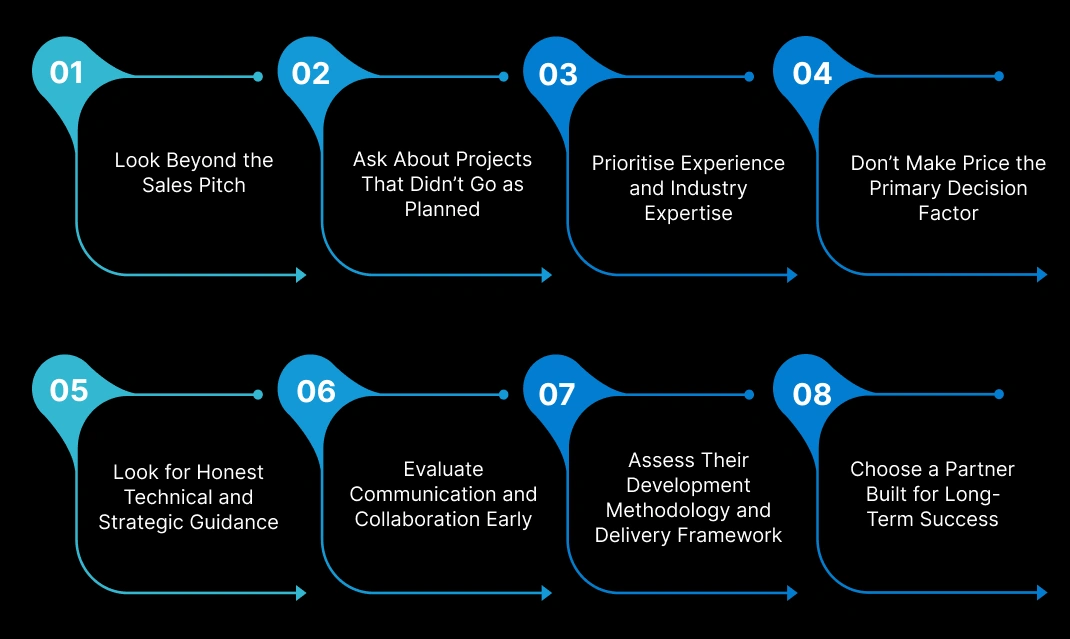
Choosing the right software development partner is one of the most important decisions for any digital initiative. The right partner becomes an extension of your team, helping you minimise risk, accelerate delivery, and build solutions that create long-term business value. Here are eight factors to evaluate before making your decision.
1. Look Beyond the Sales Pitch
A compelling presentation and an impressive portfolio can create a strong first impression, but they don’t always reflect how a company performs once the project begins. Dig deeper into their technical expertise, delivery capabilities, and consulting approach. Ask detailed questions about their development process, quality assurance practices, governance model, and how they collaborate with clients. A reliable partner should demonstrate transparency and provide clear, practical answers rather than relying solely on marketing claims.
2. Ask About Projects That Didn’t Go as Planned
Every experienced development company has encountered challenges. What differentiates exceptional partners is how they respond when things don’t go according to plan. Ask prospective vendors to share examples of projects that faced technical obstacles, changing business requirements, or timeline pressures. Their willingness to discuss failures, explain their decision-making process, and highlight lessons learned demonstrates maturity, accountability, and a strong problem-solving mindset.
3. Prioritise Experience and Industry Expertise
Experience reduces uncertainty. A development partner with years of successful project delivery across multiple industries is more likely to anticipate risks, recommend best practices, and avoid common implementation pitfalls. Industry-specific expertise is equally valuable, as it enables the team to understand regulatory requirements, customer expectations, operational workflows, and emerging technology trends without a lengthy learning curve.
4. Don’t Make Price the Primary Decision Factor
Selecting a vendor based solely on the lowest quote can lead to significantly higher costs over the project’s lifetime. Lower-cost providers may compromise on architecture, testing, documentation, security, or post-launch support, resulting in expensive rework and maintenance. Instead, evaluate the overall value offered, including technical expertise, development quality, scalability, support services, and long-term return on investment.
5. Look for Honest Technical and Strategic Guidance
The best development partners act as trusted advisors rather than order takers. They should challenge assumptions, identify potential risks, recommend alternative approaches, and provide realistic estimates for timelines and budgets. If every request is met with immediate agreement, it may indicate a lack of strategic thinking. Honest conversations during the planning phase often prevent costly surprises later in the project.
6. Evaluate Communication and Collaboration Early
Strong communication is the foundation of successful software development. Pay close attention to how responsive, organised, and transparent the team is during the evaluation process. A reliable partner provides regular updates, communicates risks proactively, documents decisions clearly, and maintains open collaboration throughout the project lifecycle. Early communication patterns are often a strong indicator of the overall working relationship.
7. Assess Their Development Methodology and Delivery Framework
Understanding how a development partner manages projects is just as important as understanding their technical capabilities. Ask about their preferred delivery methodology, sprint planning process, quality assurance practices, DevOps capabilities, security standards, governance framework, and post-deployment support. Mature delivery processes help ensure predictable timelines, better quality, reduced project risks, and continuous improvement throughout the engagement.
8. Choose a Partner Built for Long-Term Success
Software development doesn’t end with deployment. Your ideal partner should be capable of supporting future enhancements, performance optimisation, cloud scaling, security updates, integrations, and evolving business requirements. Whether they operate locally or remotely, look for a company with proven global delivery capabilities, established collaboration processes, and a long-term partnership mindset that extends well beyond project completion.
Build Software That Fits Your Business, Not the Other Way Around
Turn your vision into a scalable, secure, and future-ready solution with Q3 Technologies. Speak with our engineering team to start your project with a proven discovery approach.
What Questions Should You Ask Before You Sign a Contract?
A strong partner will answer direct questions clearly; a weak one will hedge. The following questions to ask before hiring developers are designed to surface that difference before you are financially committed.
- How do you handle scope changes that arise mid-project?
- Who, specifically, will be on our team — and does that team remain consistent from kickoff to launch?
- What happens if a deadline is missed? Who absorbs the cost or schedule impact?
- Can you provide references we can contact directly, not only quotes or testimonials?
- How would you approach our specific technical problem, in plain language, rather than a generic process description?
These questions are not designed to trap a vendor — they are designed to distinguish a partner genuinely invested in your outcome from one primarily focused on closing a deal.
Custom Software Development Company Vetting Checklist
Use this checklist as a working document during vendor evaluation. A credible partner should be able to speak to every item without hesitation.
- Proven experience in your specific industry, not only software development generally
- A transparent, documented process from kickoff through launch and beyond
- Clear, itemized pricing with no undisclosed fees
- A dedicated point of contact who understands your project in depth
- Post-launch support and maintenance built into the engagement plan
- Security and data-protection practices that can be independently verified
- Client references and reviews you can confirm directly
- Willingness to complete a small paid pilot or trial task before a full commitment
If a prospective partner is reluctant to commit to any of these points, treat that reluctance as meaningful information.
Also Read: Top Custom Software Development Trends in Australia
Why Does the Project Discovery Phase Decide Your Project’s Fate?
One step many organizations skip — at real cost — is a structured project discovery phase before development begins. This is the stage in which a partner examines business goals, end users, technical risks, and constraints, and converts an initial idea into a clear, documented plan for custom application development.
The cost of skipping this step is well documented. McKinsey’s research on large IT projects found that such projects overrun budgets by a median of 45%, and that projects exceeding $15 million in scope exceed estimates by more than 66% on average, with post-development requirement changes identified as the single largest driver of these overruns. A focused discovery period of a few weeks typically prevents months of costly rework later in the project.
Validate Your Idea Before You Invest in Development
Reduce project risk, define clear requirements, and build with confidence through our structured project discovery process.
Choosing the Right Software Development Methodology
Development teams do not all build software the same way, and the methodology a team uses shapes the entire client experience — how quickly progress becomes visible, how easily requirements can change, and how many surprises appear before launch.
The data supports a clear preference: teams using agile approaches report a 64% project success rate, compared with 49% for traditional waterfall approaches, according to 2024 Standish Group findings cited in industry research. Agile methods break work into short, testable increments, giving stakeholders visibility every few weeks rather than only at final delivery. A vendor unable to clearly explain how they plan, build, test, and adjust work in progress should be treated as a meaningful risk signal.
Why the Right Technology Foundation Makes or Breaks Your Project
Two decisions quietly determine whether software scales smoothly or becomes unstable within a few years of launch.
Technology stack: the languages, frameworks, and tools selected to build the product. These choices should be driven by your business goals, budget, and future roadmap — not simply by what a development team already knows best.
Software architecture: the underlying structural blueprint connecting every system component, from the database layer to the user interface. An architecture that is misaligned with real-world usage patterns tends to fail under production traffic regardless of how polished the interface appears. A well-matched technology stack and architecture allow custom software solutions to scale for years without requiring a costly rebuild.
Also Read: Custom ERP Software Development: A Complete Guide
How Much Should You Expect to Pay for Custom Software Development?
Budget is typically the first question on a buyer’s mind, and it deserves a transparent, range-based answer rather than a single speculative number.
| Project Type | Typical Cost Range | Examples |
|---|---|---|
| Simple applications | $15,000 – $50,000 | Basic internal tools, MVPs, single-workflow apps |
| Mid-complexity platforms | $50,000 – $150,000 | Customer portals, e-commerce systems, booking platforms |
| Enterprise-grade systems | $150,000 – $500,000+ | Deep integrations, compliance requirements, high-scale infrastructure |
| Ongoing maintenance | 15% – 20% of build cost / year | Bug fixes, monitoring, security patching, enhancements |
These figures shift based on geography, the vendor selected, and team seniority — but any company quoting a firm number before a discovery conversation has taken place is estimating, not quoting.
Why Enterprise Experience, Transparency, and Expertise Matter
Choosing the right software development partner goes beyond comparing portfolios or hourly rates. A reliable partner combines enterprise-grade technical expertise with transparent collaboration and a proven delivery track record. Look for a company that demonstrably offers:
- Enterprise project experience with complex integrations, regulatory compliance, and scalable architectures
- A transparent development process with clear communication, regular progress reporting, and realistic timelines
- Strong technical expertise across modern technologies, cloud platforms, and software architecture patterns
- A proactive, consultative approach that surfaces risk early and recommends solutions suited to your business, not just your brief
- Long-term support and maintenance to keep software secure, optimized, and aligned with evolving requirements
Pricing matters, but long-term outcomes depend on selecting a partner who delivers trust, technical rigor, and measurable business value — the qualities that separate a dependable software development company from an average vendor.
Why Choose Q3 Technologies for Custom Software Development?
With more than two decades in the industry, Q3 Technologies has built a track record of converting complex, high-stakes technical requirements into working, scalable products. Our teams hold expertise across cloud engineering, AI and automation, mobile and web platforms, quality assurance and testing, and enterprise systems integration, and we serve clients across North America, Europe, the Middle East, and Asia-Pacific.
Every engagement begins with a structured discovery process designed to remove ambiguity before development starts. Our engineering teams operate in agile sprints, providing clients with visibility into progress roughly every two weeks rather than only at major milestones.
TRANSPARENCY NOTE: Q3 Technologies is the publisher of this guide. The vetting framework, checklist, and cost benchmarks above are presented as general industry guidance intended to apply to any vendor you evaluate — not only to Q3. We encourage readers to apply the same questions and checklist to every company under consideration, including this one.
Case Study: Delivering Measurable Business Outcomes
A logistics enterprise engaged Q3 Technologies while operating manual, paper-based dispatch processes that were slowing deliveries and affecting customer satisfaction. Our team conducted a focused discovery sprint, mapped the existing operational workflow, and built a custom dispatch and tracking platform integrated with the client’s existing ERP system.
Measured outcomes included:
- A 40% reduction in manual processing time
- Real-time shipment visibility for the client’s customers
- Stable performance across two consecutive peak seasons with no reported outages
In a separate engagement, Q3 Technologies delivered a HIPAA-compliant patient portal for a healthcare technology client three months ahead of an aggressive deadline, without reducing security or compliance scope. Clients typically remain engaged with us for multiple years rather than a single project, reflecting an approach built around long-term partnership rather than one-off delivery.
Also Read: A Complete Guide to HIPAA-Compliant App Development
Final Thoughts: Your Software Partner Is a Long-Term Bet
Selecting who builds your software is one of the more consequential decisions an organization makes in a given year. Take the time to ask direct questions, insist on a genuine discovery phase, and avoid selecting a vendor on lowest bid alone. The right partner does more than write code — they help shape the operational future of the business.
Ready to start that conversation? Reach out to Q3 Technologies to begin with a discussion, not a contract.
Frequently Asked Questions
How can I evaluate a software development company’s technical expertise?
Review the vendor’s experience with your preferred technology stack, their software architecture capabilities, relevant industry case studies, verifiable client references, and any professional certifications held by the team.
Should I choose a fixed-price or a time-and-materials (T&M) engagement model?
A fixed-price model tends to work best for projects with well-defined, stable requirements. A time-and-materials model offers more flexibility for projects with evolving requirements or an agile development approach.
How should a software development company manage scope changes?
Reliable partners follow agile practices supported by a structured change-management process that formally evaluates how a new requirement affects project scope, budget, and timeline before it is approved.
Who owns the source code and intellectual property after project completion?
Your contract should explicitly state that your organization retains full ownership of the source code, intellectual property, databases, and all other project deliverables once the engagement concludes.
What should post-launch software maintenance and support include?
A sound support plan should cover bug fixes, performance monitoring, security updates, ongoing enhancements, scalability provisions, and clearly defined service-level agreements (SLAs).
Why choose Q3 Technologies for custom software development?
Q3 Technologies delivers end-to-end custom software through a structured discovery process, agile delivery, scalable architecture, and dedicated post-launch support — though we encourage readers to evaluate any vendor, including us, against the checklist in this guide.

Table of content
- What is Custom Software Development, and Why Does it Matter?
- How Do You Choose the Right Development Partner?
- What Questions Should You Ask Before You Sign a Contract?
- Custom Software Development Company Vetting Checklist
- Why Does the Project Discovery Phase Decide Your Project’s Fate?
- Choosing the Right Software Development Methodology
- Why the Right Technology Foundation Makes or Breaks Your Project
- How Much Should You Expect to Pay for Custom Software Development?
- Why Enterprise Experience, Transparency, and Expertise Matter
- Why Choose Q3 Technologies for Custom Software Development?
- Case Study: Delivering Measurable Business Outcomes
- Frequently Asked Questions
Related Case Studies


Explore More

Software Development
Top Custom Software Development Trends in Australia for 2026

Software Development
Exploring Adaptive Software Development: Key Phases and Real-World Applications

Software Development