Software Development
Top Custom Software Development Trends in Australia for 2026



Summary
Australian businesses that embrace these trends today will be better positioned to accelerate innovation, improve operational resilience, and gain a sustainable competitive advantage in an increasingly AI-driven digital economy.
The top custom software development trends in Australia are AI-native and agentic application design, cloud-native architecture, low-code/pro-code hybrid development, platform engineering and DevOps automation, security-and-compliance-by-design, and industry-specific enterprise software built for banking, healthcare, retail, and education. Australian businesses are moving away from generic, off-the-shelf tools toward custom application development that integrates AI, scales on the cloud, and meets local regulatory demands. Below, we break down each trend, back it with current market data, and show what it takes to choose the right custom software development company in Australia.
Why Custom Software Development Matters for Australian Businesses Right Now
Australia’s software development market isn’t a niche conversation anymore — it’s a boardroom priority. The Australian software development market reached an estimated USD 3.86 billion in 2025 and is projected to climb toward USD 17.33 billion by 2034, growing at a compound annual growth rate of over 18%, driven largely by enterprise digital transformation, government AI investment, and technology modernization across banking, healthcare, retail, and the public sector.
Zoom out to the broader IT services picture, and the numbers get even bigger: Australia’s software suppliers industry is valued at roughly AUD 33.8 billion in 2026, having grown at an annualized rate of close to 10% over the past five years. Enterprise software alone accounts for the largest share of custom development spend, reflecting how deeply organizations now rely on purpose-built systems — ERP, CRM, supply chain, and BI platforms — rather than generic templates.
At the same time, Australia faces a well-documented technology talent shortfall, with industry estimates pointing to well over half a million additional tech workers needed by the early 2030s. That gap is exactly why so many Australian enterprises are turning to established custom software development companies with proven global delivery models — rather than trying to build everything in-house.
This is the environment shaping every trend below.
What Are the Top Custom Software Development Trends in Australia for 2026?
1. AI-Native and Agentic Application Development
AI is no longer a bolt-on feature — it’s becoming the foundation of how custom applications are designed. Australian enterprises are moving past chatbots and predictive dashboards toward agentic AI: autonomous, multi-agent systems that can reason, use tools, retain context, and complete multi-step workflows with minimal human intervention.
This shift is backed by policy as much as technology. The Australian Government’s National AI Plan is actively steering investment into AI infrastructure, workforce training, and governance frameworks, which is accelerating enterprise appetite for AI-integrated custom application development across fintech, healthtech, and edtech.
For software teams, this means custom application development projects increasingly need to account for:
- Retrieval-augmented generation (RAG) pipelines connected to proprietary data
- Multi-agent orchestration for complex business processes
- Governance guardrails, audit trails, and human-in-the-loop checkpoints
- Integration with existing ERP, CRM, and legacy systems — not AI in isolation
2. Cloud-Native Applications as the Default, Not the Exception
Cloud-native application development has moved from “recommended” to “required.” Australia’s cloud computing market has already surpassed AUD 12 billion, and it continues to expand as businesses demand software that scales elastically, supports distributed and remote teams, and runs on pay-as-you-go economics rather than heavy upfront infrastructure.
For enterprise software solutions, cloud-native isn’t just about hosting on AWS, Azure, or Google Cloud — it’s an architectural philosophy: containerized microservices, Kubernetes-based orchestration, and API-first design that lets applications evolve without a full rebuild every time the business changes direction.
3. Low-Code Development, Paired with Pro-Code for the Hard Problems
Low-code development platforms are giving Australian business teams the ability to prototype internal tools and workflow automations without waiting months for engineering bandwidth. But the real trend for 2026 isn’t “low-code replacing developers” — it’s hybrid delivery, where low-code accelerates routine, internal-facing tools while experienced engineering teams focus custom application development effort on the systems that differentiate the business: customer-facing platforms, complex integrations, and anything touching sensitive data or core revenue logic.
This hybrid model is particularly valuable for the 99%+ of Australian businesses classified as small and medium enterprises, where budget discipline and speed-to-value both matter enormously.
4. DevOps Practices and Platform Engineering Maturity
DevOps practices have matured from “nice to have” into a baseline expectation for any enterprise software development engagement. In 2026, the trend has shifted further toward platform engineering — building internal developer platforms that standardize CI/CD pipelines, infrastructure-as-code, observability, and security scanning, so engineering teams can ship reliably without reinventing the wheel on every project.
For Australian businesses juggling distributed teams across time zones, mature DevOps practices are also what make nearshore- and offshore-augmented delivery models genuinely work — consistent automation reduces the friction that used to accompany distributed development.
5. Security and Compliance Built In, Not Bolted On
With banking, healthcare, and government driving a large share of demand for custom software, security-by-design has become non-negotiable. Australian regulatory expectations — from the Privacy Act to sector-specific frameworks — mean custom software development services now need to bake in data residency planning, encryption standards, and compliance documentation from the architecture stage, not as an afterthought before go-live.
Enterprise software development partners with recognized process maturity and information security certifications are increasingly the default choice for regulated industries, simply because the risk of retrofitting compliance is too high.
6. Industry-Specific Enterprise Software Over Generic Platforms
Generic, one-size-fits-all software is losing ground to purpose-built enterprise software solutions designed around the specific workflows of a sector — claims processing in insurance, patient engagement in healthcare, omnichannel inventory in retail, or student engagement in education. Off-the-shelf tools are being used as a starting point, then heavily customized or replaced entirely once a business hits scale.
7. Composable, API-First Architecture
Rather than monolithic platforms, Australian enterprises are increasingly building composable systems: modular services connected through well-documented APIs, so individual components — payments, identity, analytics, AI agents — can be swapped, upgraded, or scaled independently. This approach directly supports digital transformation services strategies that need to move fast without breaking what already works.
Custom Software vs. Off-the-Shelf Software: Which Is Right for Your Business?
| Criteria | Custom Software | Off-the-Shelf Software |
|---|---|---|
| Fit to business process | Built around your exact workflows | Generic; you adapt your process to the tool |
| Scalability | Designed to scale with your growth and cloud-native architecture | Often limited by vendor licensing tiers |
| Integration | Built to integrate with existing ERP, CRM, and legacy systems | May require workarounds or middleware |
| Ongoing cost | Higher upfront investment, lower long-term licensing cost | Lower upfront cost, recurring per-seat fees that grow with headcount |
| Competitive advantage | Can become a genuine differentiator | Same tool available to competitors |
| AI/automation readiness | Can embed AI, agentic workflows, and automation natively | Dependent on vendor roadmap and add-on modules |
| Best suited for | Enterprises with unique processes, compliance needs, or scale plans | Businesses with standard, well-served needs and limited customization requirements |
For many growing Australian businesses, the right answer isn’t purely one or the other — it’s starting with proven platforms for commodity functions and investing in custom application development where the business genuinely needs to differentiate.
How to Choose the Right Custom Software Development Company in Australia: A 7-Step Checklist
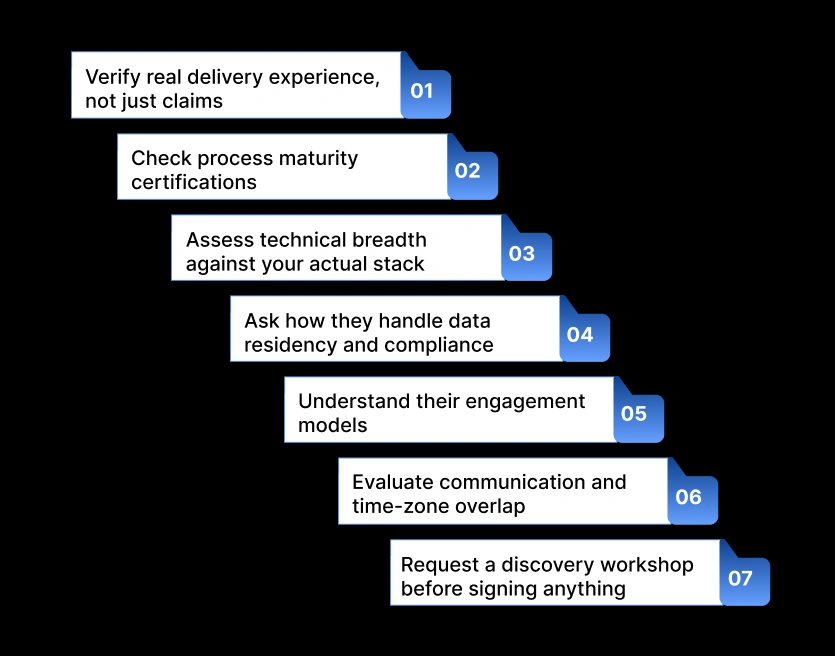
- Verify real delivery experience, not just claims: Ask for named clients, verifiable testimonials, and examples of software actually running in production — not just proposals.
- Check process maturity certifications: Look for CMMI appraisal levels and ISO 27001 certification as evidence of repeatable, secure delivery — not marketing language.
- Assess technical breadth against your actual stack: Confirm hands-on experience with cloud-native architecture, DevOps practices, and the specific AI or integration capabilities your project needs.
- Ask how they handle data residency and compliance: Especially for banking, healthcare, or government-adjacent projects operating under Australian regulatory requirements.
- Understand their engagement models: Fixed-price, dedicated team, or staff augmentation — and whether they can flex as your project scope evolves.
- Evaluate communication and time-zone overlap: For distributed delivery to work, you need structured stand-ups, transparent reporting, and a single point of accountability.
- Request a discovery workshop before signing anything: A credible partner will want to understand your business problem deeply before quoting a solution.
Real-World Example: Agentic AI in Production for an Australian EdTech Institution
Theory is easy. Production is where custom software development trends get tested. Q3 Technologies has designed and deployed a multi-agent AI assistant for one of Australia’s leading EdTech institutions — a live system currently serving thousands of students.
The engagement reflects exactly the shift discussed above: agentic reasoning and orchestration layered onto existing systems, built to behave reliably in production rather than as an isolated AI experiment. It’s the kind of outcome that only comes from combining AI engineering with decades of enterprise software delivery discipline — understanding how a new AI layer needs to integrate with student data systems, existing workflows, and real usage patterns at scale.
“AI agents are not a research experiment for us — they are software that has to run alongside existing systems, integrate with real data, and behave reliably in production.” — Q3 Technologies, Agentic AI Development Services
Read Our Case Study: Reimagining Student Support with a Multimodal, AI-Powered Assistant for Australia’s Leading EdTech Institution
Expert Insight: What This Means for Australian Businesses in 2026
From Q3 Technologies‘ enterprise engineering practice, one pattern stands out across banking, healthcare, retail, and education clients: the businesses winning with custom software in 2026 aren’t the ones chasing every new trend — they’re the ones sequencing trends correctly. Cloud-native architecture and DevOps maturity typically need to be in place before AI initiatives can scale reliably. Skipping that groundwork is the single most common reason ambitious AI projects stall after the pilot stage.
For CIOs and IT decision-makers, the practical takeaway is to audit infrastructure readiness first, then layer in AI-native capabilities and industry-specific enterprise software on a foundation that can actually support them.
Also Read: Custom Software Development Process: Key Steps Before You Build
Frequently Asked Questions
What is custom software development, and how is it different from off-the-shelf software?
Custom software development involves designing and building applications tailored to a specific business’s workflows, data, and goals, rather than adapting a generic, pre-built product. It typically offers better long-term fit, scalability, and integration with existing systems.
Why are Australian businesses investing more in custom software in 2026?
Growth is being driven by enterprise digital transformation, government AI investment through the National AI Plan, a persistent tech talent shortage, and the limitations of generic software for complex or regulated industries like banking and healthcare.
Is custom software development more expensive than buying off-the-shelf software?
Custom software usually requires a higher upfront investment but avoids recurring per-seat licensing costs and can be built to scale exactly with your business, often making it more cost-effective over the long term for growing enterprises.
What industries in Australia benefit most from custom enterprise software solutions?
Banking and finance, healthcare, retail, education, and government are seeing the strongest demand, largely because their workflows, compliance requirements, and data sensitivity are difficult to satisfy with generic platforms.
What is agentic AI, and why is it relevant to custom application development?
Agentic AI refers to AI systems that can reason, use tools, retain context, and autonomously complete multi-step tasks. In custom application development, it’s used to automate complex workflows that previously required significant manual effort.
Should my business choose low-code development or custom-coded software?
It depends on the use case. Low-code development is well-suited to internal tools and rapid prototyping, while custom-coded, pro-code development is better for customer-facing platforms, complex integrations, and anything handling sensitive data at scale. Many businesses now use both.
How long does a typical custom software development project take in Australia?
Timelines vary widely by scope, but a well-defined enterprise application typically takes anywhere from three to twelve months from discovery to production launch, depending on integration complexity and whether AI or automation components are involved.
What should I look for in a custom software development company in Australia?
Look for verifiable client testimonials, recognized process maturity certifications like CMMI, information security certifications such as ISO 27001, relevant technical experience with cloud-native and AI systems, and a transparent engagement and communication model.
How does cloud-native architecture benefit enterprise software?
Cloud-native architecture allows applications to scale elastically, support distributed teams, and evolve incrementally through modular, containerized services — instead of requiring a full rebuild every time business needs change.
Can custom software be integrated with our existing ERP or CRM systems?
Yes. A core advantage of custom application development is the ability to design integrations specifically for your existing ERP, CRM, and legacy systems, rather than relying on generic connectors that may not fit your data model.
What role does DevOps play in custom software development?
DevOps practices — including CI/CD automation, infrastructure-as-code, and continuous monitoring — allow custom software to be delivered faster, deployed more reliably, and maintained with fewer production issues over time.
How do I know if my business needs digital transformation services versus a single custom application?
If the need is isolated to one workflow or department, a single custom application may be enough. If multiple systems, teams, and processes need to modernize together — often involving cloud migration, automation, and AI — that points toward a broader digital transformation services engagement.

Table of content
- Why Custom Software Development Matters for Australian Businesses Right Now
- What Are the Top Custom Software Development Trends in Australia for 2026?
- Custom Software vs. Off-the-Shelf Software: Which Is Right for Your Business?
- How to Choose the Right Custom Software Development Company in Australia: A 7-Step Checklist
- Real-World Example: Agentic AI in Production for an Australian EdTech Institution
- Expert Insight: What This Means for Australian Businesses in 2026
- FAQs
Related Case Studies