Software Development
AI-Native Software Development vs. Traditional Development: What Enterprises Need to Know


Summary
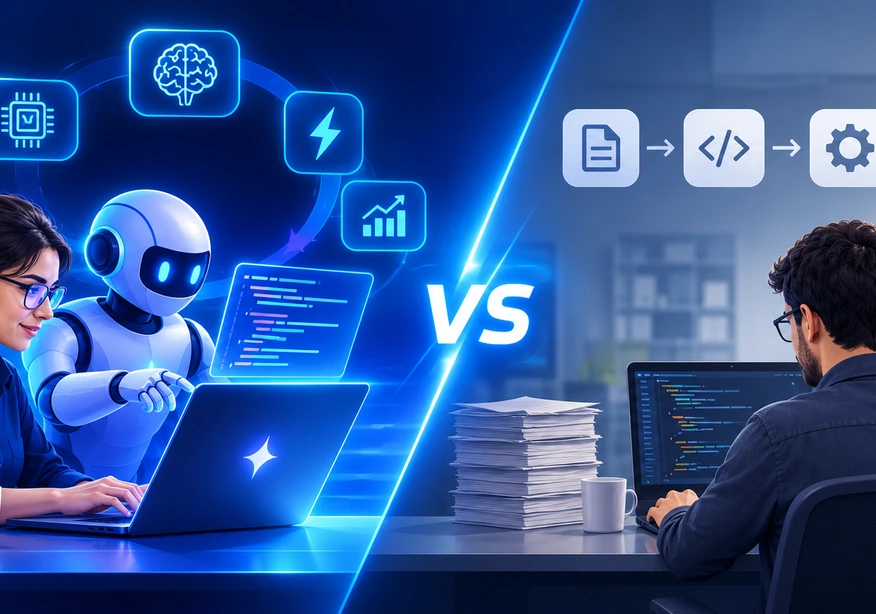
AI-native software development is an approach in which AI is built into every phase of the software development lifecycle (SDLC), from requirements and design to coding, testing, deployment, and operations. AI agents handle a significant share of the work, while engineers define context, set constraints, and own quality and architecture. In traditional development, humans author and verify each stage, and AI, if used at all, is an add-on tool.
While developing Q3 Technologies’ whitepaper on the AI-native software development lifecycle, our team spoke with engineering leaders who were, almost without exception, asking the same thing: “We’ve rolled out AI coding tools to everyone. Why hasn’t delivery fundamentally changed?”
The answer is that most enterprises have adopted AI-assisted coding inside a traditional process. Developers autocomplete faster, but requirements, reviews, testing, release approvals, and handoffs still move at the speed they did before. The bottleneck simply moves downstream.
The scale of the shift is hard to ignore. Gartner predicts that by 2028, 90% of enterprise software engineers will use AI code assistants, up from less than 14% in early 2024. It also names AI-native software engineering as a top strategic trend, describing it as embedding AI into every SDLC phase so that AI can autonomously or semi-autonomously handle a significant share of tasks.
Yet integration is proving difficult. In a Gartner survey of 400 software engineering leaders, 77% identified building AI capabilities into applications as a significant or moderate pain point, and 71% said the same about using AI tools to augment software engineering workflows.
What is AI-Native Software Development?
AI-native software development is a way of building software in which the process itself is designed around AI from the start. Rather than asking “Where can we add AI to our existing workflow?”, AI-native teams ask “If AI agents can draft, test, and refactor code, how should we redesign the lifecycle around that capability?”
Gartner’s Philip Walsh describes the new mindset well: in the AI-native era, engineers will focus on “steering AI agents toward the most relevant context and constraints” for each task.
It helps to see AI adoption in software engineering as a spectrum:
| Stage | What it looks like | Who does most of the work |
|---|---|---|
| Traditional | Manual coding, manual testing, human reviews; AI not used | Engineers |
| AI-assisted coding | Autocomplete, chat-based code suggestions, inline explanations | Engineers, with AI help |
| AI-driven software development | AI generates tests, documentation, and code modules on request across several phases | Shared between engineers and AI |
| AI-native software development | Lifecycle redesigned around agents; AI drafts, tests, reviews, and monitors, with humans setting intent and approving | AI agents, directed and governed by engineers |
Also Read: Agentic AI vs Traditional AI Agents: Which One Powers Next-Gen Automation?
How is AI-Native Development Different from Traditional Software Development?
Traditional software development methods, whether waterfall, agile, or DevOps, assume that humans are the primary producers of every artifact: requirements documents, designs, code, test cases, and release notes. AI-native development assumes AI can produce first drafts of most of these, and that human expertise is best spent on judgment.
| SDLC phase | Traditional development | AI-native development |
|---|---|---|
| Requirements | Business analysts write user stories manually | AI drafts stories and acceptance criteria from interviews, tickets, and legacy specs; analysts refine |
| Design and architecture | Architects produce designs from scratch | AI proposes options against defined patterns and constraints; architects decide |
| Coding | Developers write most code by hand | Agents generate code from specifications; developers review, adapt, and own critical logic |
| Testing | QA writes and maintains test suites; coverage often lags | AI generates unit, integration, and regression tests continuously alongside code |
| Code review | Peer review of every change | AI pre-review for security, style, and defects; humans review design and business logic |
| Documentation | Frequently outdated or skipped | Generated and updated automatically with each change |
| Operations | Manual triage of alerts and incidents | AI-assisted root-cause analysis and suggested remediation |
| Key metric | Velocity and story points | Lead time, change failure rate, and AI output acceptance rate |
Three differences matter most for enterprise leaders.
- Context becomes a strategic asset. AI agents are only as good as the context they receive: architecture standards, domain rules, APIs, and past decisions. AI-native teams invest in context engineering, which means making this knowledge structured, current, and accessible to agents.
- Verification replaces authorship as the bottleneck. When code can be generated in minutes, the scarce resource is the ability to confirm it is correct, secure, and maintainable. Automated testing, policy checks, and skilled reviewers become the critical path.
- Team shape changes. Smaller, senior-heavy teams can direct more output, and Gartner also expects generative AI to enable 40% of software team members to come from nontraditional engineering backgrounds. Roles such as AI workflow designer and prompt and context librarian are starting to appear.
Expert View
“Traditional software development follows a largely sequential approach, where each phase depends on predefined processes and manual intervention. AI-native development introduces an intelligent, continuous engineering model in which AI agents and generative AI capabilities support decision-making, automate repetitive tasks, and enable faster feedback loops. This shift allows engineering teams to focus more on innovation, complex problem-solving, and delivering measurable business outcomes.” – Gaurav Kothari, VP of Engineering
What Are the Benefits of AI-Native Software Development for Enterprises?
Based on what we see in enterprise programs, the benefits cluster into five areas:
- Faster time to market. Shorter cycles from idea to production, because drafting, testing, and documentation run in parallel rather than in sequence.
- Higher, more consistent test coverage. AI can generate tests for every change, closing the coverage gaps that typically accumulate under deadline pressure.
- Legacy modernization at scale. AI can read, explain, and help refactor older codebases, making modernization projects that were previously too expensive worth reconsidering.
- Better developer experience. Engineers spend less time on boilerplate and more on design and problem-solving. DORA’s 2025 research found more than 80% of respondents believe AI has increased their productivity.
- Living documentation and knowledge retention. Systems stay documented as they change, which reduces dependency on individual experts.
Ready to Embrace AI-Native Development?
Accelerate software innovation with AI-powered engineering expertise from Q3 Technologies.
The Risks and Hidden Costs Enterprises Must Plan For
AI-native development is not a free lunch, and I’d be doing readers a disservice to suggest otherwise. These are the issues that most often derail programs:
- The trust gap. DORA’s 2025 report describes AI as an amplifier: it magnifies the strengths of high-performing organizations and the dysfunctions of struggling ones. Without strong review and testing, faster output can simply mean faster defects.
- Security of generated code. AI can introduce vulnerable patterns, outdated dependencies, or licensing issues. Automated security scanning and software composition analysis must run on every AI-generated change.
- Escalating token costs. Agentic workflows consume far more compute than simple autocomplete. Gartner’s warning that AI coding costs could exceed the average developer’s salary by 2028 makes usage monitoring and model selection a budget issue.
- Skills erosion. Junior developers who rely on AI without understanding its output may not build the judgment senior engineers depend on. Mentoring and deliberate practice need to be designed in.
- Governance and IP. Enterprises need clear policies on which tools are approved, what code and data can be shared with models, and who is accountable for AI-generated changes.
When Traditional Development Still Makes Sense
AI-native is not the right answer for every system. Traditional, human-led methods remain the better choice for safety-critical code where certification requires full traceability of human authorship, for highly novel algorithms with little prior art for models to draw on, and for small, stable systems where the overhead of redesigning the process outweighs the gains. Most enterprises will run a hybrid model for years, applying AI-native practices where risk is manageable and value is highest.
A Five-Step Roadmap to Adopting AI-Native Software Development
- Assess your foundations. Evaluate test automation, CI/CD maturity, code quality, and documentation. AI will amplify whatever it finds.
- Choose a lighthouse project. Pick a bounded, high-value initiative, such as a module modernization or a new internal application, with measurable outcomes.
- Engineer the context. Codify architecture standards, coding conventions, domain rules, and API contracts so agents can use them consistently.
- Build guardrails into the pipeline. Add automated security scans, policy checks, human approval gates for sensitive changes, and cost monitoring for AI usage.
- Measure, then scale. Track lead time for changes, deployment frequency, change failure rate, time to restore service, and AI output acceptance rate. Expand to more teams only when the data supports it.
How Q3 Technologies Applies AI-Native Development for Enterprises
At Q3, AI-native engineering is how we approach custom software development and modernization, not a separate offering. Our delivery model, supported by ISO 27001-certified security practices, typically includes:
- AI-native readiness assessment: A review of the client’s SDLC, toolchain, codebase health, and team skills, with a prioritized adoption plan.
- Context and knowledge engineering: Structuring architecture standards, domain logic, and legacy system knowledge so AI agents produce consistent, compliant output.
- Governed AI pipelines: CI/CD pipelines with built-in AI code review, automated test generation, security scanning, and human approval gates.
- Legacy modernization accelerators: Using AI to analyze, document, and incrementally refactor legacy applications while keeping business logic intact.
- Upskilling and change management: Training client teams to work effectively alongside AI agents, including review practices and responsible use.
Client spotlight: A multi-agent AI assistant for Australia’s leading EdTech institution
Australia’s leading EdTech institution was dealing with rising student query volumes that its LMS couldn’t handle. Around half of staff time went on repetitive questions about courses, deadlines, and policies, and students were waiting hours for answers.
Q3 Technologies engineered a multimodal, multi-agent AI assistant with three specialized agents. The first identifies the intent of each query. The second pulls live, course-specific data from the LMS. The third searches policy documents, handbooks, and course files through retrieval-augmented generation (RAG). The assistant is built API-first on React, Node.js, Python, OpenAI, and LangChain, so it can work with different LMS platforms and scale to thousands of users with secure access.
The results:
- Query resolution time fell from 4 hours to 8 minutes.
- Staff time spent on routine queries dropped from 50% to under 5%.
- 99.9% of students now have 24/7 intelligent guidance.
Why it matters for AI-native development: Agents worked within clearly defined roles, drew on structured context, and ran on an API-first architecture that keeps AI output accurate and scalable.
Quick Tips for Engineering Leaders
- Don’t measure lines of code. Track lead time, change failure rate, and how often AI output is accepted without major rework.
- Treat prompts and context as code. Version them, review them, and share them across teams.
- Keep humans on the critical path for architecture, security-sensitive logic, and production releases.
- Set an AI usage budget per team before agentic tools scale, not after the first invoice.
- Pair juniors with seniors on AI review so judgment is learned, not skipped.
Build Smarter Software with AI
Partner with Q3 Technologies to build intelligent, scalable, and future-ready software solutions.
Is Your Enterprise Ready for AI-Native Development?
AI-native software development is quickly becoming one of the defining enterprise software development trends of this decade. The organizations that benefit most will not be the ones that adopt AI tools first. They will be the ones that rebuild their process, governance, and skills around those tools deliberately.
With 25+ years of enterprise software delivery experience, Q3 Technologies helps engineering leaders make that shift with measurable results.
Download our whitepaper, The AI-Native Software Development Lifecycle to see where your teams stand today.
Frequently Asked Questions
What is AI-native software development?
AI-native software development is an approach that embeds AI into every phase of the software lifecycle, with AI agents producing a significant share of requirements, code, tests, and documentation while engineers set direction, define constraints, and verify quality.
How is AI-native development different from traditional software development?
In traditional development, humans create and verify every artifact. In AI-native development, AI produces first drafts across the lifecycle and humans focus on context, review, architecture, and accountability. The process, metrics, and team roles all change.
Is AI-assisted coding the same as AI-native development?
No. AI-assisted coding adds tools such as code completion to an existing workflow. AI-native development redesigns the workflow itself around AI capabilities across all SDLC phases.
What are the benefits of AI-native software development for enterprises?
Key benefits include faster time to market, higher test coverage, more affordable legacy modernization, improved developer experience, and documentation that stays current as systems change.
What are the risks of AI-native software development?
The main risks are insecure or low-quality generated code, rising AI usage costs, skills erosion among junior engineers, and gaps in governance and intellectual property policy. Each can be managed with automated checks, cost monitoring, and clear policies.
Will AI-native development replace software engineers?
No. It changes what engineers spend their time on. Demand is shifting toward engineers who can design systems, provide context to AI, and judge the quality and security of AI-generated work.
How should an enterprise start with AI-native development?
Start by assessing engineering foundations, then run a bounded lighthouse project with clear metrics, invest in context engineering and pipeline guardrails, and scale based on measured results.

Table of content
- What is AI-Native Software Development?
- How is AI-Native Development Different from Traditional Software Development?
- What Are the Benefits of AI-Native Software Development for Enterprises?
- The Risks and Hidden Costs Enterprises Must Plan For
- When Traditional Development Still Makes Sense
- A Five-Step Roadmap to Adopting AI-Native Software Development
- How Q3 Technologies Applies AI-Native Development for Enterprises
- Client spotlight: A multi-agent AI assistant for Australia’s leading EdTech institution
- Quick Tips for Engineering Leaders
- Frequently Asked Questions
Related Case Studies


Explore More
Software Development
What is Agile Software Development Process, Benefits & Best Practices

Software Development
Custom Software Development Process: Key Steps Before You Build

Software Development